12 DIY Cat Toys You Can Make for Under $5
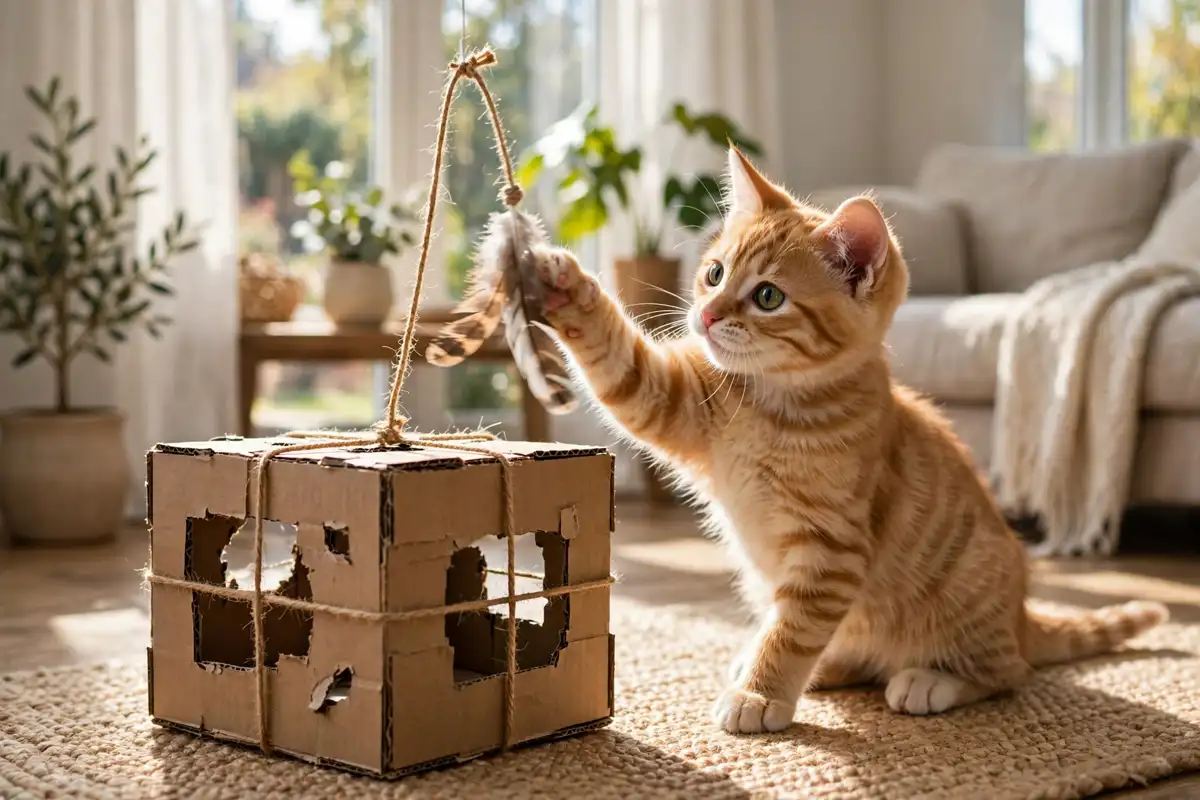
Here is a secret every cat owner learns sooner or later: the toys your cat actually plays with are rarely the expensive ones. A crumpled receipt, a cardboard box, a paper bag on its side — cats are hardwired to chase, pounce, and hide, and the simplest household objects trigger those instincts better than most $20 gadgets. You can build genuinely great cat toys from scraps and dollar-store basics for under $5 each, and many cost nothing at all.
This guide gives you 12 easy DIY cat toy ideas made from cardboard, paper, and common household items, plus the safety rules that keep homemade playtime risk-free. Pick one this weekend and watch your cat ignore everything else in the house.
Why DIY Toys Work So Well for Cats
Cats hunt by sight, sound, and touch. A toy succeeds when it moves unpredictably, makes a little noise, or hides something interesting. Store-bought toys often fail because they are static — the cat bats them twice, learns the pattern, and walks away. Homemade toys from paper, cardboard, and feathers stay unpredictable: they crinkle, rustle, tear, and fall apart in ways that keep a cat's brain engaged.
There is also the rotation factor. Because DIY toys cost pennies, you can throw them away when they get gross and make fresh ones. A constant supply of "new" toys keeps play exciting without the spending. Check out our Care Guides for more budget-friendly cat care ideas, and the homepage for the full library of cat tips.
The 12 DIY Cat Toys
1. The Classic Cardboard Box Fort
Cost: free. Cut doorways and windows into a large box, tape a second box on top, and you have a multi-room fortress. Cats spend hours inside, on top, and ambushing ankles through the windows. Replace it when it collapses — there is always another box.
2. Toilet Paper Roll Puzzle Feeder
Cost: free. Fold one end of an empty roll closed, drop in a few treats, fold the other end, and toss it to your cat. They have to bat, roll, and chew it open to get the reward. It turns snack time into a hunting game.
3. Crumpled Paper Balls
Cost: free. The undisputed champion of cat toys. Tightly crumple a sheet of printer paper or a receipt and toss it — it bounces unpredictably and makes that perfect rustling sound. When it goes flat, crumple a new one.
4. Feather Wand From a Stick
Cost: about $1. Tie a few craft feathers (or strips of fleece) to a sturdy stick or dowel with thick cord. Drag it along the floor, flick it over the sofa, and let your cat stalk and pounce. Always put it away after play — never leave dangling cord unsupervised.
5. Paper Bag Hideout
Cost: free. Lay a paper grocery bag on its side with the opening propped up and drop a crumpled paper ball inside. Cats dive in, rustle around, and leap out. Cut off the handles first — they are a strangulation hazard.
6. Sock Catnip Mouse
Cost: about $1. Fill a lone sock with a spoonful of dried catnip and a little stuffing or crumpled paper, then tie the end in a knot. Most cats bunny-kick it for twenty minutes straight, then nap on it like a pillow.
7. Bottle Cap Hockey
Cost: free. Save a few plastic bottle caps and flick them across a hard floor. They skid, spin, and slide unpredictably — perfect prey behavior. Use larger caps and skip this one if your cat tries to chew small pieces off.
8. Cardboard Scratcher Ramp
Cost: free. Cut strips of corrugated cardboard, stack and glue them edge-up into a wedge or block. Sprinkle with catnip and place it near the sofa. It satisfies the scratching urge and saves your furniture.
9. Ice Cube Treasure Hunt
Cost: free. Drop a treat or a small toy into each compartment of an ice cube tray, cover with water, and freeze. Pop one out on a warm day — your cat gets a cold puzzle that melts into a reward. Messy, but gloriously entertaining.
10. Ping Pong Ball Bathtub Races
Cost: about $1. Drop a few ping pong balls into an empty bathtub or shower. The curved walls keep the balls bouncing back for round after round of chasing. It is loud, it is chaotic, and cats absolutely love it.
11. Muffin Tin Foraging Game
Cost: free. Put a treat in each cup of a muffin tin, then cover every cup with a ball or a crumpled paper wad. Your cat has to figure out how to uncover each one — a genuine brain workout disguised as snack time.
12. T-Shirt Tent
Cost: free. Drape an old t-shirt over two chairs or a small frame to make a tent. Cats treat it as a secret hideout and a pouncing launchpad in one. Wash it occasionally — cat tents get gloriously disgusting.
DIY Cat Toy Safety Rules
Homemade toys are safe when you follow a few non-negotiable rules. First, no string, yarn, or ribbon left unsupervised — swallowed string can cause life-threatening intestinal damage, so wand toys get put away after every session. Second, avoid small detachable parts: no buttons, googly eyes, or small bells a cat could chew off and swallow. Third, skip anything sharp — remove staples, smooth tape edges, and avoid cans with cut rims. Fourth, inspect toys regularly and retire them when they start falling apart. Finally, supervise new toys the first few times so you learn how your particular cat plays — every cat has their own brand of chaos.
Frequently Asked Questions
Are homemade cat toys safe?
Yes, as long as you follow a few rules: no small parts that can be swallowed, no string or yarn left unsupervised, no sharp staples or tape edges, and no toxic materials like treated wood or painted cardboard. Inspect DIY toys regularly and throw them away when they start falling apart.
Why does my cat prefer the box to the expensive toy inside it?
Boxes trigger your cat's instincts: they are enclosed hiding spots with interesting textures and smells. Most store-bought toys are static and predictable, while a cardboard box is a tunnel, a fortress, and a scratching post in one. Lean into it — the box is genuinely enrichment.
Can I use yarn or string for DIY cat toys?
Only during supervised play, and put it away afterward. String is one of the most dangerous household items for cats — swallowed linear foreign bodies can cause severe intestinal damage requiring surgery. Use thick cord or shoelaces instead of thin thread, and never leave dangling strings unattended.
How often should I rotate my cat's toys?
Every week or two. Cats lose interest in toys they see every day, but a toy that disappears for a fortnight feels brand new when it comes back. Keep a small box of DIY toys in a closet and swap a few out on a regular schedule.
What household items are dangerous for cats to play with?
Avoid rubber bands, hair ties, small plastic caps, batteries, sharp-edged cans, plastic bags with handles (strangulation risk), and anything with small detachable parts like googly eyes or buttons. Also keep sewing supplies, medications, and anything coated in paint or chemicals out of play areas.