How to Give a Cat a Pill (Without the Drama)
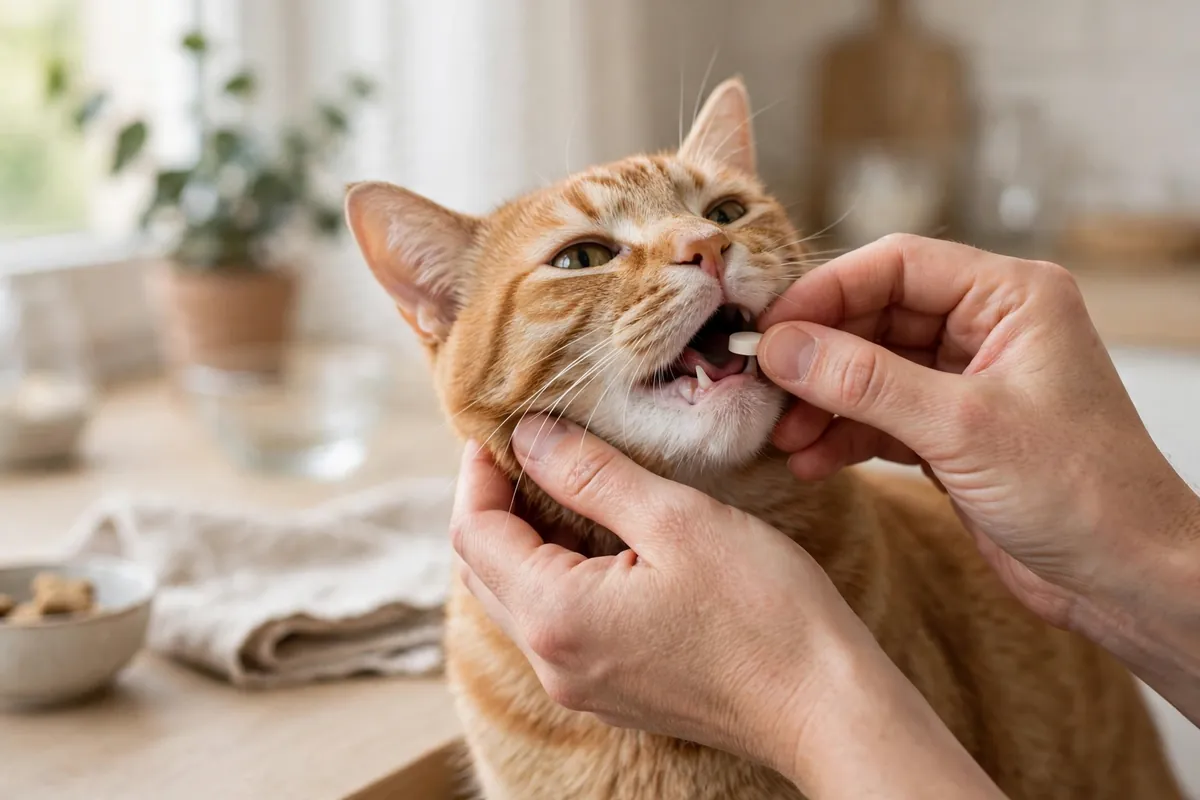
The fastest reliable way to give a cat a pill: stay calm, tilt your cat's head back gently, place the pill as far back on the tongue as you can, close the mouth, and stroke the throat until they swallow. Done smoothly, the whole thing takes under two minutes — and with a little practice, under thirty seconds.
If that sounds optimistic, you are not alone. The good news: pilling is a skill, not a talent. The cats that "can't be pilled" almost always belong to owners who were never shown the technique. This guide walks you through the calm method step by step, the towel trick for squirmers, the tools that help, and sneaky food hacks for uncooperative cats. Find more practical skills in our cat care guides here at Purrfect Paws.
Before You Start: Setup Is Everything
Most pilling disasters happen before the pill ever reaches the mouth. Set yourself up properly and half the battle is won:
- Pick a calm moment. Not right after playtime, not when the doorbell just rang. A sleepy, relaxed cat is dramatically easier to pill.
- Work in a small, quiet room. A bathroom with the door closed beats an open-plan living room — fewer escape routes, fewer distractions.
- Have everything ready. Pill out of the bottle, a small syringe of water or a favorite treat within reach, and clean hands. Fumbling for supplies mid-pill gives your cat time to plan their escape.
The Direct Method, Step by Step
This is the technique vets and vet techs use dozens of times a day. It looks intimidating but becomes second nature fast:
- Position your cat. Place them on a table at a comfortable height, facing away from you — or sit with them tucked between your knees. Steady, not pinned.
- Open the mouth. With your non-dominant hand, rest it over the top of your cat's head with your thumb on one side of the jaw and forefinger on the other, just behind the canine teeth. Tilt the head gently upward — the lower jaw will naturally drop open.
- Place the pill far back. With your dominant hand, use a fingertip (or a pill popper, see below) to drop the pill as far back on the tongue as you can reach. The further back, the harder it is to spit out — this single detail makes the biggest difference.
- Close and encourage the swallow. Gently hold the mouth closed, keep the head tilted slightly up, and stroke the throat downward. A soft puff of air on the nose or a tiny touch to the nose with a wet fingertip can trigger the swallow reflex.
- Follow with water. Offer a small syringe-drop of water or a lick of wet food right after. This washes the pill down the esophagus — important, because pills can lodge in a cat's throat and cause irritation if swallowed dry.
- Verify. Watch for the unmistakable swallow, then peek inside the mouth and along the cheeks. Some cats are master "cheekers" who hold the pill in a cheek pouch and spit it out theatrically two minutes later.
The Towel Burrito (for Squirmers)
For cats that turn into four-legged blenders, the towel wrap is a game changer. Spread a large towel on a table, place your cat in the center, and wrap them snugly like a burrito — paws tucked in, only the head sticking out. Tuck the ends underneath so they cannot wriggle free, then proceed with the direct method above. Keep it snug but never tight around the chest, and work efficiently.
Try a Pill Popper (Pill Gun)
A pill popper — sometimes called a pill gun or pill syringe — is a cheap plastic tool with a soft rubber tip that holds the pill and a plunger that releases it. It lets you place the pill far back on the tongue without putting your fingers near the teeth, which is reassuring if your cat has ever bitten down mid-pill. Load the pill into the tip, open the mouth as described above, slide the tip to the back of the tongue, and press the plunger. Then close the mouth and encourage the swallow exactly as before. Many vet clinics sell them for a few dollars, and they are worth every cent.
The Sneaky Route: Hiding Pills in Food
Some cats will never accept the direct approach, and that is fine — stealth works too, with a few rules:
- Use a tiny, irresistible vehicle. A pill pocket, a pea-sized ball of wet food, or a dab of cream cheese around the pill. The portion must be small enough to swallow in one or two bites — a big meatball gets chewed, discovered, and rejected.
- Go in hungry. Offer the doctored treat when your cat is a little hungry (before a meal, not after) so they gulp rather than inspect.
- Confirm the whole dose is eaten. Watch them finish it. Cats are notorious for eating around a pill and leaving it gleaming in the bowl.
- Check with your vet first. Some medications must be given on an empty stomach, and some cannot be given with dairy or certain foods. A quick call saves a wasted dose.
When Your Cat Spits It Out Every Single Time
First, the golden rule: never re-dose on your own if you are unsure how much was absorbed. If the pill comes back up whole and intact five seconds later, it is reasonable to try again — but if there is any doubt, call your vet before giving more. Doubling up on some medications can be dangerous.
If pilling is a daily war, stop fighting and change the battlefield. Ask your vet about alternatives: many medications come as flavored liquids, some can be compounded into tasty chicken- or fish-flavored treats by a compounding pharmacy, certain drugs (like the common thyroid medication methimazole) can be applied as a gel to the ear flap, and some treatments are available as long-acting injections given at the clinic. There is almost always another route — you just have to ask.
What Not to Do
- Do not chase your cat around the house pill in hand. Every chase teaches them that pilling time means terror time, making tomorrow harder.
- Do not tilt the head back extremely far — a slight tilt opens the jaw; an extreme tilt risks the pill going down the wrong way.
- Do not dissolve the pill in a full water bowl or mix it into a whole meal. You cannot control the dose, and most cats will refuse the tainted food or water entirely.
- Do not crush or split pills without asking your vet. Many pills have coatings that control how the drug releases; crushing can dump the whole dose at once or destroy it in stomach acid — plus it tastes awful.
- Never give dog medication or human medication to a cat. Cats metabolize drugs very differently, and common painkillers like ibuprofen and paracetamol are toxic to them.
With patience and the right technique, medicating your cat becomes just another part of the routine — like trimming nails: nobody's favorite task, but entirely manageable. Your cat will forgive you. Probably by dinner.
Frequently Asked Questions
Can I crush my cat's pill and mix it into food?
Only if your veterinarian says it is okay. Some pills have coatings that control how the drug is released, and crushing destroys that. Crushed medication also tastes intensely bitter, which can cause drooling, foaming, or vomiting — and a cat that refuses the food gets no dose at all.
How do I know my cat actually swallowed the pill?
Watch for a distinct swallow, then gently check inside the mouth and along the cheeks afterward. Experienced cats are expert at pocketing pills in their cheeks and spitting them out minutes later, so always verify.
What should I do if my cat vomits right after taking a pill?
Call your veterinarian before giving another dose. If the pill came straight back up intact, none was likely absorbed — but some medications absorb very quickly, and doubling up can be dangerous. When in doubt, ask.
My cat foams at the mouth with liquid medicine. Is that normal?
Foaming is usually just a reaction to a bitter taste, not a medical emergency on its own. Ask your vet about a flavored compounded version — chicken or fish flavoring makes most liquid medications far more tolerable.
Can I skip a dose if pilling my cat is too difficult?
Missing doses can make treatment fail, especially with antibiotics where stopping early lets the infection rebound. If pilling is a battle, ask your vet for an easier formulation — a flavored liquid, a compounded treat, or a long-acting injection — instead of skipping.