Is My Cat Overweight? 3 Tests
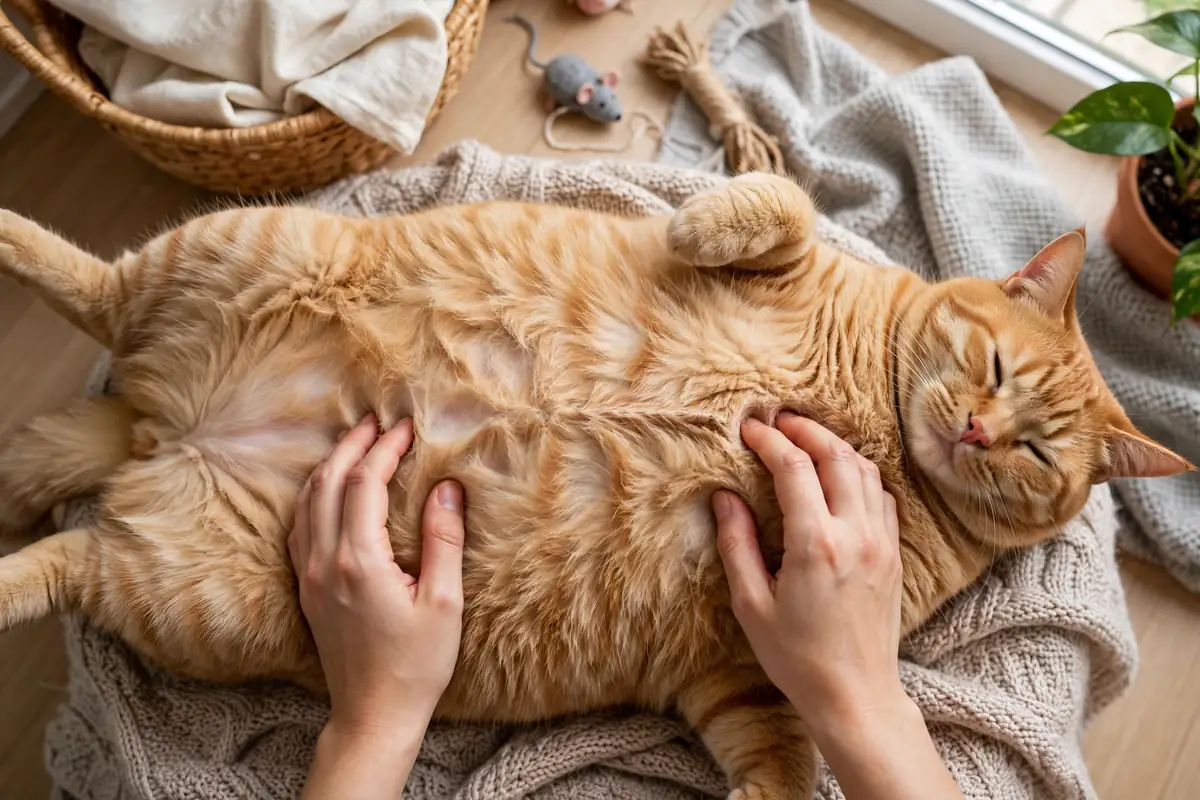
Is my cat overweight, or just a big, fluffy cat? It is one of the most common questions cat owners ask, and it is harder to answer by eye than most people expect. Long fur hides body shape, some breeds are naturally large, and a little extra weight creeps on so gradually that you barely notice it. The good news is that you do not need a scale or a vet degree to get a reliable answer — three simple at-home tests, done in under two minutes, will tell you where your cat stands.
Extra weight is not just cosmetic: overweight cats face higher risks of diabetes, arthritis, urinary problems, and liver disease. But there is a trap to avoid — cutting food drastically can be dangerous. This guide covers the three tests, the primordial pouch (the belly flap that is not fat), and a safe, vet-guided weight-loss plan.
Why the Scale Alone Does Not Tell the Story
A cat's healthy weight depends on breed, frame, age, and sex, so no single number fits every cat. A sturdy Maine Coon can be perfectly healthy at a weight that would be far too heavy for a petite Siamese. That is why veterinarians use a body condition score instead of weight alone: a hands-on, eyes-on assessment of fat cover and body shape, usually scored from 1 (very thin) to 9 (very obese), with 4 to 5 considered ideal.
The three tests below mirror a vet's body condition check. Use all three together — one alone can mislead, especially in long-haired cats, but when all three agree, trust the result.
Test 1: The Rib Feel
How to do it: Wait until your cat is relaxed, then place both hands flat on either side of their ribcage, just behind the front legs. Press gently, as if you were feeling through a thin blanket. Run your fingers slowly over the ribs.
What healthy feels like: You can feel each rib easily under a thin layer of fat. You should not have to press hard, and you should not see the ribs sticking out.
What overweight feels like: You have to press firmly to find the ribs at all, or you cannot feel them under a thick, spongy layer. If your cat's sides feel like a well-padded cushion rather than a ribcage, extra weight is likely.
Watch out: In long-haired cats, part the fur and feel the ribs directly rather than judging by the fluffy outline.
Test 2: The Waist From Above
How to do it: Stand above your cat while they are standing normally on all four paws — not sitting, not stretched out — and look straight down at their body.
What healthy looks like: You should see a gentle inward curve behind the ribs — a visible waist, like a subtle hourglass shape. The body narrows slightly before widening again at the hips.
What overweight looks like: The body is straight from ribs to hips, or bulges outward, with no inward curve at all. From above, an overweight cat looks like a rounded rectangle or an oval rather than an hourglass.
Watch out: Check a naturally standing cat — one mid-stretch, crouched, or just after a large meal will not show their true shape.
Test 3: The Belly Tuck From the Side
How to do it: Crouch to your cat's level and look at them from the side while they stand normally. Follow the line of the belly from the chest back toward the hind legs.
What healthy looks like: The belly line rises upward toward the back legs — a gentle tuck. The abdomen sits higher than the chest line, giving a tucked-in profile.
What overweight looks like: The belly hangs level with, or below, the chest line, with no upward tuck. In clearly overweight cats, the belly may sag noticeably and swing when they walk.
Watch out: Do not confuse this with the primordial pouch (explained next): it hangs low even in lean cats, but the belly line should still tuck upward above it.
Primordial Pouch vs Fat: How to Tell the Difference
Almost every cat owner has spotted it: a loose flap of skin and tissue hanging along the belly, swinging gently when the cat runs. This is the primordial pouch, and it is completely normal. All cats have one, including slim, athletic cats. It is thought to protect the abdomen during play and fights and to let the cat stretch fully when running and jumping.
Tell pouch from fat by feel: the pouch is loose, soft, and swings freely, moving like empty skin when lifted gently. Fat feels firm and evenly distributed, padding the ribs, back, and sides as well as the belly. Ribs easy to feel plus a visible waist plus a swinging flap means pouch, not obesity; buried ribs, no waist, and a round, firm belly means extra fat — pouch or not.
What the Three Tests Mean Together
- All three healthy: ribs easy to feel, waist visible, belly tucks up. Your cat is likely at a healthy weight. Keep up measured feeding and daily play.
- One test borderline: for example, ribs slightly padded but waist and tuck still present. Watch portions and recheck in a month — this is the easiest stage to correct.
- Two or three tests pointing to overweight: ribs hard to feel, no waist, no tuck. It is time for a vet visit to confirm a body condition score and set a safe target weight.
Safe Weight Loss: What to Do (and What NOT to Do)
Do: start with a vet visit for a target weight and calorie plan; measure every meal instead of free-feeding; keep treats to a small share of daily calories; add daily play; and weigh your cat every two to four weeks.
Do NOT: put your cat on a crash diet. Rapid weight loss — especially in an overweight cat that stops eating — can trigger hepatic lipidosis, or fatty liver disease, a life-threatening condition in which fat floods the liver when the body burns reserves too fast. Weight loss must be slow, steady, and vet-guided, typically around 1 to 2 percent of body weight per month. Never starve a cat, skip meals entirely, or switch to a drastically reduced diet without veterinary guidance.
When to Call the Vet: Red-Flag Checklist
Book a vet visit promptly — urgently if the sign is severe — if you notice any of these:
- Your cat refuses food entirely for more than 24 hours (a kitten: more than 12 hours).
- Rapid or unexplained weight loss, or sudden weight gain.
- Vomiting, diarrhea, or straining to urinate alongside weight change.
- Greatly increased thirst or urination, which can signal diabetes.
- Difficulty breathing, extreme lethargy, collapse, or seizures.
- Your cat cannot jump, groom, or move comfortably — possible arthritis made worse by weight.
- You are unsure whether the belly flap is a pouch or fat, or you need a safe calorie plan.
Frequently Asked Questions
How can I tell if my cat is overweight at home?
Use three checks: you should feel the ribs with light pressure but not see them, there should be a visible waist when viewed from above, and the belly should tuck upward from the side. If all three point the same way, you have a good picture of your cat's condition.
What is a cat's primordial pouch?
The primordial pouch is a normal flap of loose skin and fat along a cat's belly, present in all cats including lean ones. It protects the abdomen during play and fights and allows full stretching. It swings when a cat runs and is not, by itself, a sign of obesity.
How fast should an overweight cat lose weight?
Weight loss must be slow and vet-guided — roughly 1 to 2 percent of body weight per month is a commonly used safe pace. Rapid weight loss, especially in an overweight cat that stops eating, can trigger hepatic lipidosis (fatty liver disease), which is life-threatening.
Is my cat fat or just fluffy?
Fluff fools the eyes, so use your hands: part the fur and feel the ribs, and look at the body shape from above and the side. A fluffy cat at a healthy weight still has a waist and ribs you can feel easily; a truly overweight cat feels padded over the ribs and has no waist.
What should I feed an overweight cat?
Do not simply cut portions drastically or switch foods without advice. Ask your vet for a target weight and calorie plan, measure every meal, cut back treats, and build in daily play.