Why Does My Cat Follow Me to the Bathroom?
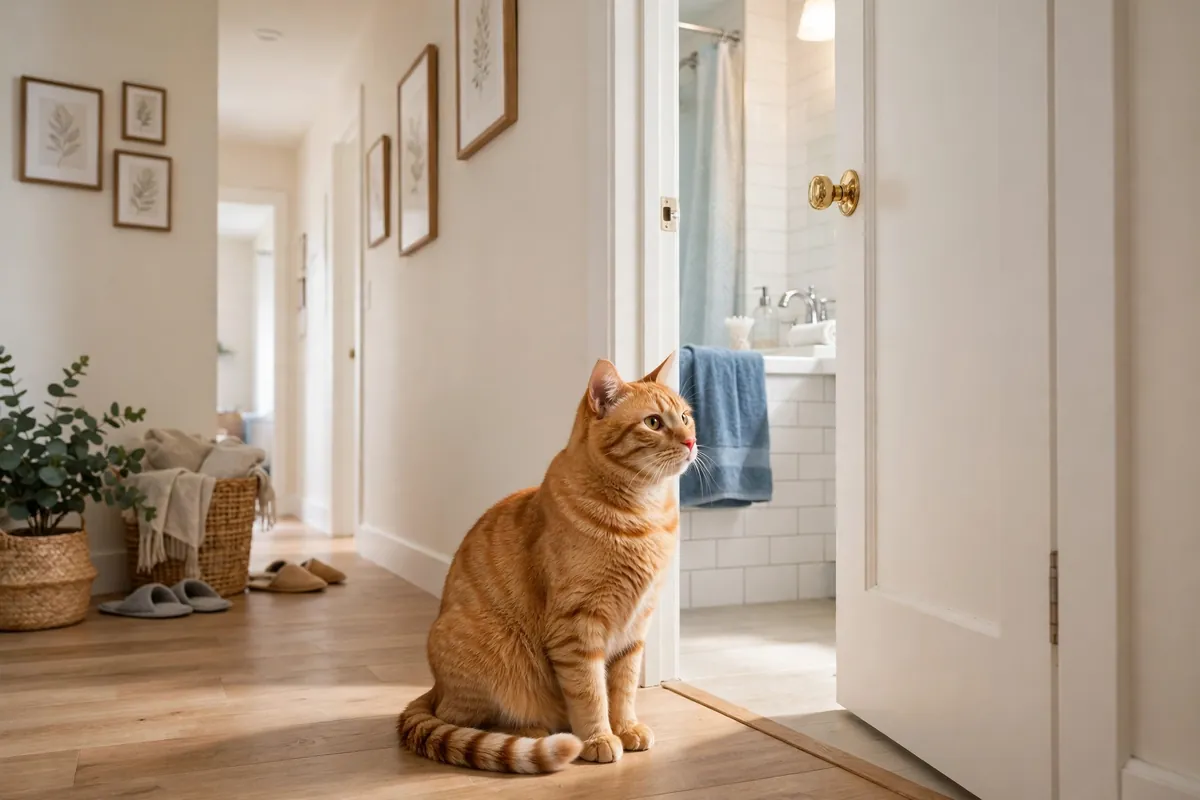
If your cat follows you to the bathroom, the short answer is that you are part of their territory — cats are deeply territorial animals, and being separated from you by a closed door goes against every instinct they have. Add in the bathroom's running water, fascinating smells, and rustling toilet paper, plus a captive human with nothing else to do but pay attention, and you have the most interesting room in the house from a cat's perspective. In most cases it's completely normal and even affectionate — but occasionally, clingy bathroom behavior can signal separation anxiety or boredom worth addressing.
It is one of the most universal cat-owner experiences: you head for the bathroom, hear the familiar patter of paws behind you, and find yourself with an audience. Some cats sit and stare, some paw at the door if you dare close it, and some simply must supervise every visit. Funny as it is, the behavior is rooted in genuine feline instincts — territory, routine, curiosity, and social bonding — and understanding it makes you appreciate your little shadow even more.
Territory Instincts: You Belong to Your Cat
The number-one reason cats follow you to the bathroom is territory. Your home is your cat's domain, and in your cat's mind, so are you — cats mark their territory (and their favorite people) by rubbing their cheeks and flanks against them, depositing scent from facial glands. When you disappear behind a closed door, you have temporarily left the territory unmonitored, and that bothers them.
Closed doors are uniquely frustrating to cats for this reason. A cat doesn't understand privacy; it understands that part of its domain is suddenly inaccessible, which triggers an instinct to investigate and reclaim it. That's why the pawing, meowing, and dramatic door-sitting escalate specifically when the door is shut — an open bathroom door gets far less protest. Many owners find the "problem" vanishes the moment they simply leave the door ajar.
This territorial devotion is actually a compliment. Your cat isn't being nosy — it's keeping track of a valued member of its social group.
Routine, Curiosity, and the Mystery of the Closed Door
Cats are creatures of fierce routine. They learn your patterns astonishingly fast — the morning bathroom trip, the before-bed visit — and they insert themselves into those patterns because predictability feels safe. Following you becomes part of their routine too, which is why the behavior is so consistent: same human, same door, same time, every day.
Curiosity does the rest. Cats are hardwired to investigate anything novel or hidden, and a door that opens and closes around you several times a day is endlessly suspicious. What's in there? Why do you keep going in alone? The feline mind, presented with a recurring mystery, does what it always does: supervises it personally.
There's also a social-bonding layer. Cats that are strongly bonded to their owners — the ones that greet you at the door, sleep on your pillow, and "talk" to you — follow you everywhere, and the bathroom is no exception. If your cat also trails you to the kitchen and the bedroom, the bathroom visits are simply one stop on the full-house patrol. You can read more about these bonding behaviors in our cat behavior guides.
The Bathroom Is Fascinating: Water, Sounds, and Captive Attention
Look at the bathroom through feline eyes and it's basically an amusement park:
- Running water. Dripping faucets and flushing toilets mesmerize cats — moving water triggers both curiosity and a deep drinking instinct, since wild cats learn that running water is safer than stagnant water.
- Interesting smells. Soaps, shampoos, and cleaning products carry strong scents cats feel compelled to investigate (keep actual cleaners safely stored — many are toxic to cats).
- Rustling toilet paper. To a cat, an unrolling ribbon of paper is a prey-like toy that never runs out. Bathroom doors get scratched partly in pursuit of this treasure.
- Cool, smooth surfaces. Sinks and bathtubs are delightfully cool napping spots, especially in warm weather — many cats claim the sink as a bed the moment it's empty.
- A captive audience. Perhaps the biggest draw: in the bathroom you are sitting still, facing one direction, with empty hands. From your cat's perspective, you have finally stopped being busy and become available for attention.
None of this is misbehavior — it's a cat being a cat in the most stimulating room of the house.
Separation Anxiety in Cats: 5 Signs It's More Than Curiosity
Most bathroom-following is harmless, but in some cats it reflects genuine separation anxiety — distress when apart from their person. Watch for these signs that the clinginess goes deeper than curiosity:
- Excessive vocalization when separated — prolonged crying, yowling, or meowing at closed doors, not just a few curious chirps.
- Destructive behavior in your absence — scratched doorframes, knocked-over objects, or shredded items that appear specifically when you're gone.
- Over-grooming — licking the belly or legs bald is a classic feline stress response.
- Appetite or litter box changes — eating much less (or more) than usual, or avoiding the litter box when stressed.
- Shadowing you everywhere, constantly — a cat that can't settle in another room even for a few minutes and panics rather than merely complains at barriers.
Separation anxiety often appears after a trigger: a move, a new work schedule, a new pet or baby, or the loss of a companion animal. If several signs cluster together and the behavior is new, it's worth addressing rather than laughing off. For the full picture of feline wellbeing, explore Purrfect Paws — healthy routines and enrichment guides live alongside the behavior explainers.
What to Do About a Bathroom-Obsessed Cat
For the normal, non-anxious bathroom follower, you barely need to do anything — but a few tweaks make life smoother for both of you:
- Leave the door ajar if you can. Most door-drama is about the barrier, not the room. An open door usually produces a calm supervisor rather than a frantic paw under the gap.
- Never punish the following. Scolding or spraying a cat for wanting to be near you damages trust and can convert mild clinginess into real anxiety.
- Enrich the rest of the house. Puzzle feeders, a window perch with a bird view, and rotating toys give your cat rewarding things to do besides patrol your movements — boredom amplifies clinginess.
- Build independent play into the day. Two 10–15 minute interactive play sessions (wand toy, fetch, chase) burn energy and build confidence, making solo time easier.
- Keep departures and arrivals low-key. If your cat is anxious when you leave the house entirely, calm, boring goodbyes teach them that separations are uneventful and always end with your return.
- Cat-proof the bathroom. Store cleaners in latched cabinets, keep the toilet lid down (small kittens can fall in), and secure medications — if your cat will be in there, make it safe.
See a vet or feline behaviorist if clinginess appeared suddenly in an adult cat, especially alongside appetite, litter, or grooming changes — sudden behavior shifts can have medical roots, from thyroid issues to cognitive changes in seniors. Otherwise, enjoy your tiny supervisor: few creatures on earth care as much about your whereabouts as a cat that follows you to the bathroom.
Frequently Asked Questions
Why does my cat cry outside the bathroom door?
A closed door blocks your cat's access to its territory (you included), which is genuinely frustrating for a territorial animal. If you open the door, reward calm behavior by waiting for a quiet moment rather than opening mid-yowl — that teaches patience instead of demanding.
Should I let my cat in the bathroom with me?
That's entirely personal preference, and there's no harm in it as long as the bathroom is cat-proofed: cleaners locked away, toilet lid down, medications secured. Many owners simply leave the door ajar and let the cat choose.
Why does my cat stare at me while I'm on the toilet?
You're finally sitting still with empty hands and nowhere to go — prime attention opportunity. Cats also monitor their social group as a safety instinct. The unblinking supervision is equal parts affection, curiosity, and making sure you don't do anything interesting without them.
Do cats really get separation anxiety?
Yes. Cats bond deeply with their people, and changes like a new schedule, a move, or a lost companion can trigger real distress — vocalizing, destructiveness, over-grooming, and appetite changes. It's less common than in dogs but absolutely real, and enrichment plus routine help most mild cases.
My cat never used to follow me — why start now?
A new clingy streak usually has a trigger: a schedule change, a move, a new pet, boredom, or aging. In senior cats, increased neediness can also reflect cognitive decline or medical issues like hyperthyroidism. If the change is sudden and paired with other behavior shifts, a vet check is the smart move.