Why Does My Cat Hiss at Nothing?
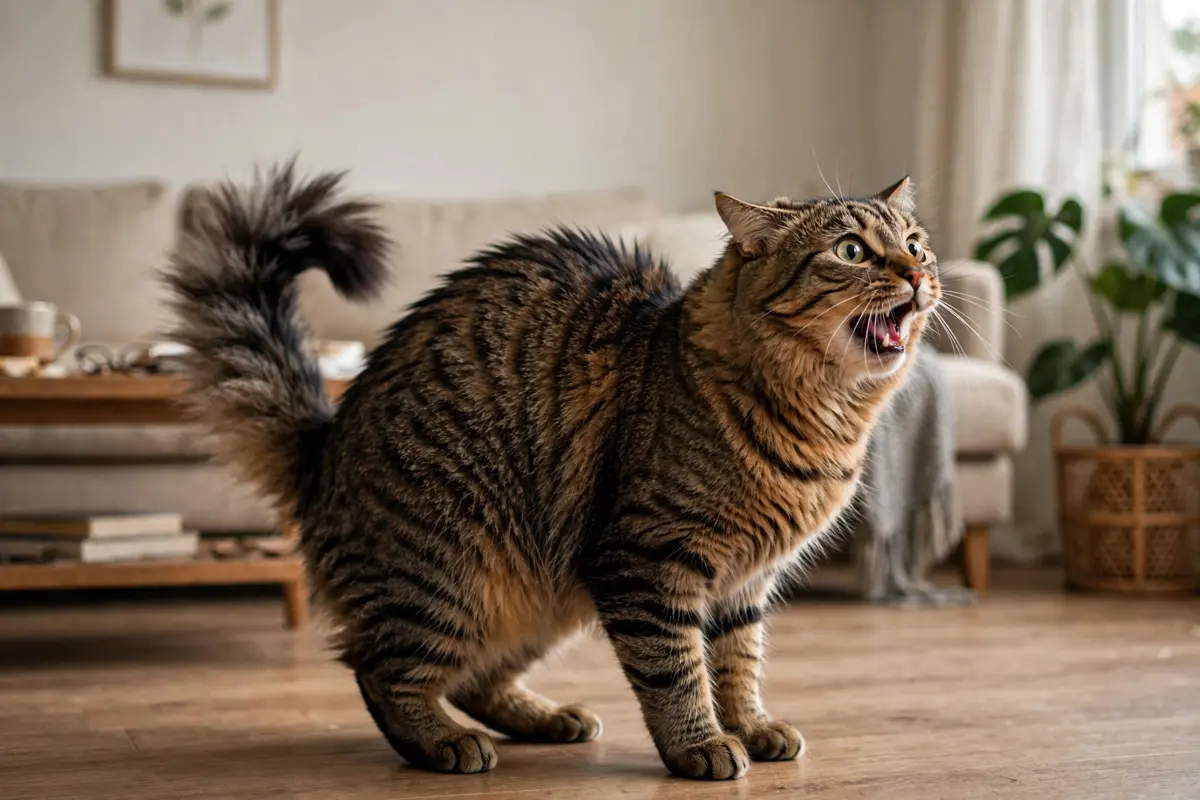
You are sitting quietly on the sofa when your cat suddenly locks eyes on an empty corner, arches her back, and lets out a full-throated hiss — at absolutely nothing you can see. It is unsettling, and it is tempting to joke about ghosts. But your cat is never hissing at "nothing." She is reacting to something real that your human senses simply cannot detect.
Cats hear frequencies we cannot, smell traces we miss entirely, and feel vibrations through their whiskers and paws. A hiss that looks random to you is almost always a response to a sound, scent, memory, or discomfort. Here are the 7 hidden reasons behind the mystery hiss — and how to respond so your cat feels safe again.
First: Your Cat’s Senses Are Not Your Senses
Before we decode the hiss, it helps to appreciate the hardware. Cats hear sounds up to about 64 kHz — humans top out around 20 kHz — which means your cat may be reacting to a neighbor's dog whistle, an ultrasonic pest repeller, or mice moving inside the walls. Their sense of smell is roughly 14 times stronger than ours, and their whiskers detect air currents and vibrations. When your cat hisses at "nothing," she is usually responding to a perfectly real stimulus that exists below your threshold of perception.
So the right question is never "why is my cat crazy?" It is "what did my cat notice that I missed?"
7 Hidden Reasons Cats Hiss at Seemingly Nothing
- She hears something you cannot. High-frequency sounds — a TV on standby emitting a whine, an electronic device, rodents in the walls, a distant dog whistle — can startle or irritate a cat. If the hissing happens in the same spot repeatedly, listen for electronics and consider what might be humming, buzzing, or clicking just out of your range.
- She smells something alarming. Cats live by scent. The lingering odor of another animal on your clothes or shoes, a new cleaning product, a visitor's perfume, or even the vet-clinic smell on a returning housemate cat can trigger a defensive hiss. To your cat, an unfamiliar scent in her territory is never "nothing."
- She is in pain. This is the reason to take most seriously. A cat that hisses when touched in a particular spot, when jumping down, or seemingly out of nowhere may be guarding a painful tooth, an arthritic joint, or an injury. Pain hissing often comes with flinching, hiding, or a sudden change in litter box or grooming habits. New, unexplained hissing in a normally sweet cat deserves a vet check.
- She was startled. Cats are ambush-hunters wired to react first and think later. A sudden movement in peripheral vision, a dropped object, or being woken abruptly can produce an instant hiss that fades within seconds. This is pure reflex — the feline equivalent of yelping when someone sneaks up on you.
- She is setting a boundary during play. Play that tips past the fun line — too-rough petting, a belly rub that went on one stroke too long, a high-energy wrestling session — often ends with a hiss that means "that's enough." This is healthy communication, not aggression. The cat is telling you exactly where the line is.
- Redirected frustration. Your cat sees a strange cat through the window, cannot reach it, and hisses at the nearest available target — you, another pet, the sofa. The emotion is real; the target is just whoever happened to be close. Redirected hissing usually follows staring out windows or pacing near doors.
- She is remembering something scary. Cats form powerful negative associations with places and objects. A cat once frightened by a vacuum cleaner may hiss at the closet where it lives. A rescue cat may hiss at a broom, a raised hand, or a particular sound that echoes a bad past experience. The trigger is a memory, and memories are invisible — hence the "nothing."
What NOT to Do When Your Cat Hisses
How you react in the moment matters enormously. A hiss is communication, not defiance — punishing it teaches your cat that warning you is unsafe, which can escalate to biting without warning instead.
- Never yell, clap, or punish. It confirms that the situation is indeed dangerous and destroys trust.
- Do not corner or chase. A hissing cat needs space, not confrontation. Back off and give her an exit route.
- Do not force affection to "prove" everything is fine. Let the cat come to you when she is ready.
- Do not stare back. Direct, sustained eye contact reads as a challenge. A slow blink, then looking away, says the opposite.
How to Calm a Hissing Cat
Once you have given her space, help the environment do the calming work:
- Lower the stimulation: dim harsh lights, turn down loud media, and keep other pets and visitors away for a while.
- Offer a safe retreat — a covered bed, a box, or a quiet room — and let her choose to emerge on her own schedule.
- Reintroduce yourself gently later with a slow blink and a hand held low for sniffing, not reaching over her head.
- If a specific trigger is identifiable (a new scent, a noisy appliance), remove or mask it. Feliway-style calming diffusers can help in multi-trigger households.
- Keep a short log: when it happens, where, and what preceded it. Patterns reveal triggers far faster than memory.
Understanding feline body language is a skill that pays off daily — our Cat Behavior guides decode everything from slow blinks to tail flicks, and the Purrfect Paws homepage has the full collection.
When Hissing Signals a Vet Visit
Occasional hissing at startling stimuli is normal cat behavior. But book a vet appointment if the hissing is new and persistent, directed at being touched or handled, paired with appetite loss, hiding, limping, or litter box changes, or escalating in frequency. Pain and illness are among the most common causes of behavior changes in cats, and they are also the most treatable — catching them early is a kindness.
Your cat is not haunted and not broken. She is a finely tuned sensory instrument telling you, in the clearest language she has, that something in her world needs attention. Listen to the hiss, find the "nothing," and you will both be calmer for it.
Frequently Asked Questions
Why does my cat hiss at me for no reason?
There is always a reason, even if it is invisible to you — an unfamiliar scent on your clothes, a startle, redirected frustration from something she saw outside, or pain when touched. Track when it happens and what came just before; the pattern usually reveals the trigger.
Is it normal for cats to hiss at nothing?
Occasional hissing at startling sounds, strange smells, or during overstimulating play is completely normal communication. What is not normal is sudden, frequent, or escalating hissing in a cat that did not do it before — that warrants a vet check for pain or illness.
Should I punish my cat for hissing?
Never. Hissing is a warning, not misbehavior — it is your cat asking for space instead of biting. Punishing it suppresses the warning without removing the cause, which can lead to bites with no warning at all. Give space, then address the trigger.
Why does my cat hiss at new smells?
Scent is identity to a cat. A new perfume, a visitor's pet smell on your jacket, or the vet-clinic odor on a returning housemate can make a familiar person or cat smell like a stranger — and strangers in the territory get hissed at. The reaction usually fades as the scent becomes familiar.
Can cats see things humans can’t?
Not ghosts — but their other senses genuinely outperform ours. Cats hear ultrasonic frequencies, smell traces we miss, and detect vibrations through whiskers and paw pads. A hiss at an “empty” room is usually a response to a sound, scent, or vibration you cannot perceive.