Cat Zoomies at 3AM: Why It Happens
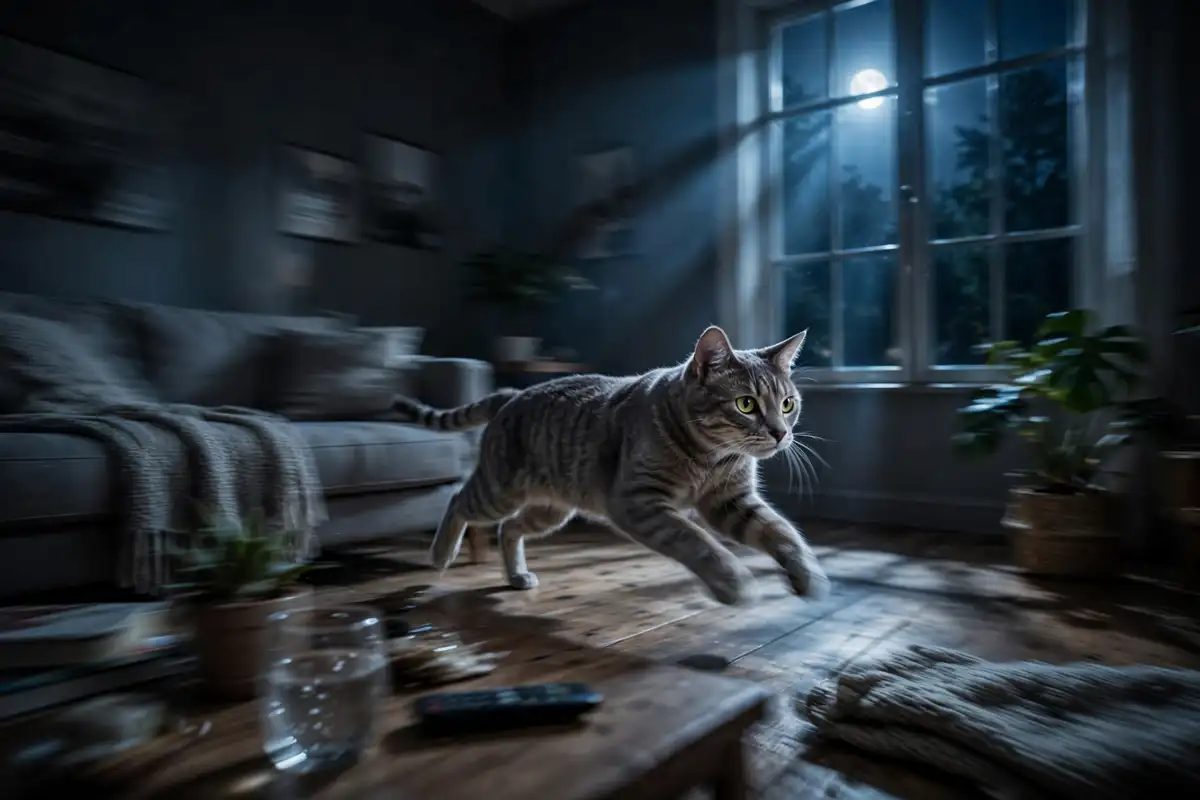
It is 3 a.m. The house is dark and silent — until a thunder of paws erupts down the hallway and a shape launches off the couch and vanishes under the bed. Congratulations: your cat has the zoomies. The short answer is that cats are crepuscular — naturally most active at dawn and dusk — and a day of naps leaves them with a full battery of pent-up energy to burn when the lights go out. Behaviorists call it FRAPs (Frenetic Random Activity Periods), and it is completely normal in healthy cats. Here is what triggers the midnight sprint, when it might signal a problem, and six ways to shift that energy to a more human-friendly hour.
What Are the Zoomies, Exactly?
"Zoomies" is the internet's name for what behaviorists call FRAPs — Frenetic Random Activity Periods. A FRAP is a sudden, short burst of intense activity: sprinting from room to room, skidding around corners, leaping onto and off furniture, sometimes finishing with a dramatic sideways hop. Episodes usually last a few seconds to a few minutes, and afterward the cat often flops down as if nothing happened. In cats the episodes are especially theatrical, thanks to their explosive fast-twitch muscles and love of vertical space. Zoomies are an expression of physical joy and excess energy — a cat mid-zoom is doing what its body was built to do. It just looks ridiculous because the "prey" is a hallway.
Why 3AM? The Crepuscular Clock
Cats are crepuscular — naturally most active at dawn and dusk, the twilight hours when their wild ancestors hunted and when a cat's night vision gives the biggest advantage. Your indoor cat's day works against your sleep schedule: while you are at work, your cat sleeps through most of the daylight hours, so by bedtime that battery is fully charged. Around 3 a.m., the house is quiet, dark, and still — prime hunting conditions. The mismatch is worst for under-stimulated indoor cats: one that spent the day alone with no play has a huge surplus of unspent energy, and the 3 a.m. hallway sprint is that surplus leaving the building. More of these feline mysteries are decoded in our Cat Behavior guides.
6 Common Triggers Behind the Midnight Sprint
- After using the litter box. The famous post-poop zoomies: relief after passing stool, plus the instinct to sprint away from where waste was left. A victory lap after the litter box is perfectly normal.
- After a long nap. Cats wake up like athletes warming up — with a burst of movement. A cat that slept four straight hours wakes with a full tank and an urge to move. If the nap ends at 2:30 a.m., you get the 3 a.m. show.
- Boredom. A cat with nothing to do all day invents something to do at night. Under-exercised indoor cats are the most frequent midnight zoomers — and this is the trigger you have the most control over.
- Pent-up hunting instinct. Even well-fed house cats carry a predatory toolkit — stalking, chasing, pouncing. Zoomies are often a hunt with no target: the sprint is the chase, the skid is the pounce. Interactive play satisfies this drive directly.
- Excitement. Some cats zoom after a satisfying meal, a good play session, or when a favorite human comes home late. Positive arousal tips over into a burst of running, like a happy dog doing laps around the coffee table.
- Another animal's energy. In multi-cat households, one cat's zoomies are contagious. The second cat joins the sprint — or starts a chase game — and suddenly you have a two-cat Grand Prix at an unsociable hour.
Are Cat Zoomies Ever a Sign of a Problem?
For most cats, zoomies signal health, not illness. But unusual hyperactivity deserves a closer look:
- A sudden change in pattern. A senior cat that never zoomed and suddenly starts racing restlessly is different from a two-year-old with a standing 3 a.m. appointment. New, out-of-character restlessness is worth mentioning to your vet.
- Restlessness that never stops. Normal zoomies are bursts — a few minutes, then calm. Pacing or agitation that goes on and on, especially with vocalizing, looks more like distress than play.
- Hyperthyroidism in older cats. In seniors, new hyperactivity with weight loss despite a big appetite, increased thirst, or vomiting can point to an overactive thyroid — common and very treatable once diagnosed.
- Pain or skin irritation. A cat that sprints, then suddenly stops to bite at its back or tail, could be reacting to fleas, allergies, or a skin condition. The running is a reaction, not the issue.
- Stress or anxiety. Cats in a disrupted household sometimes show frantic behavior that looks like zoomies but comes with hiding, appetite changes, or litter box avoidance. Playful zoomies come with a relaxed cat before and after; stressed running does not.
The rule of thumb: zoomies plus a happy, healthy cat equals normal; zoomies plus any symptom or behavior change equals a vet visit.
6 Ways to Tame the 3AM Zoomies
You cannot erase the dawn-and-dusk instinct, but you can drain the battery earlier — turning the 3 a.m. show into a 10 p.m. encore. These work best in combination:
- Schedule a pre-bed play session. About an hour before bed, play 10–15 minutes with a wand toy. Mimic prey: let the toy hide, dart, and "escape," and let your cat catch it several times, ending with a final big catch.
- Feed after play, then sleep. In the wild, the sequence is hunt, eat, groom, sleep. Recreate it: play, then a meal, and your cat's biology does the rest. A full, tired cat is far more likely to sleep through the night.
- Make daytime less boring. A window perch with a bird view, rotating toys, a puzzle feeder, and cardboard boxes to ambush from all give your cat daytime things to do. See more ideas on the Purrfect Paws home page.
- Build a consistent evening routine. Play, dinner, and lights-out at roughly the same times each night teaches your cat when the day ends. Most cats adjust within a couple of weeks.
- Give them a quiet nighttime outlet. If your cat must move at night, make it quiet and safe: a cat tree for climbing, soft toys instead of jingly balls, and rugs on hard floors to muffle the sprints.
- Consider a companion. A second cat can tire out a lonely, bored single cat — they play and wrestle together. Only do this if you genuinely want another cat, and introduce them gradually.
What NOT to Do About Nighttime Zoomies
- Do not punish the zoomies. Yelling, spraying water, or chasing teaches your cat you are scary at 3 a.m., not that running is wrong. Punishment damages trust and can create anxiety behaviors worse than sprinting.
- Do not join in loudly. Laughing or chasing your cat at 3 a.m. rewards the exact behavior you want to move. Stay boring — if you must get up, be calm and uninteresting.
- Do not lock them away without resources. Shutting a cat in a bare room all night increases stress and vocalizing. If you close your bedroom door, leave food, water, a litter box, and toys on their side of it.
- Do not skip the vet when the pattern changes. If the zoomies are new, frantic, or paired with other symptoms, get a checkup before assuming it is behavioral.
Frequently Asked Questions
What are the zoomies called in cats?
FRAPs — Frenetic Random Activity Periods: short, explosive bursts of running, jumping, and skidding when a cat releases built-up energy. In cats, FRAPs peak at dawn and dusk, matching their natural crepuscular rhythm.
Why does my cat get zoomies after using the litter box?
Post-poop zoomies are extremely common: relief after passing stool, plus the instinct to sprint away from where waste was left. Either way, it is normal.
Do cats grow out of the zoomies?
Kittens and young cats zoom the most. Most calm down between ages 2 and 4, and seniors may rarely zoom — though plenty of healthy adults keep a weekly or nightly sprint for life.
Are zoomies at night a sign my cat is stressed?
Usually not — nighttime zoomies in an otherwise happy cat are just energy release and considered normal. Stress looks different: pacing, excessive grooming, hiding, or agitation that does not stop. If the running seems frantic, or comes with appetite or litter box changes, see your veterinarian.
How do I stop my cat from running around at 3AM?
Tire them out before bed: 10–15 minutes of interactive play that mimics hunting, then a meal, then lights out. Puzzle feeders, a consistent evening routine, and daytime enrichment shift energy earlier. You cannot erase the instinct, but you can move most sprinting to the evening.