Cat Weight Checker: Is My Cat Overweight?
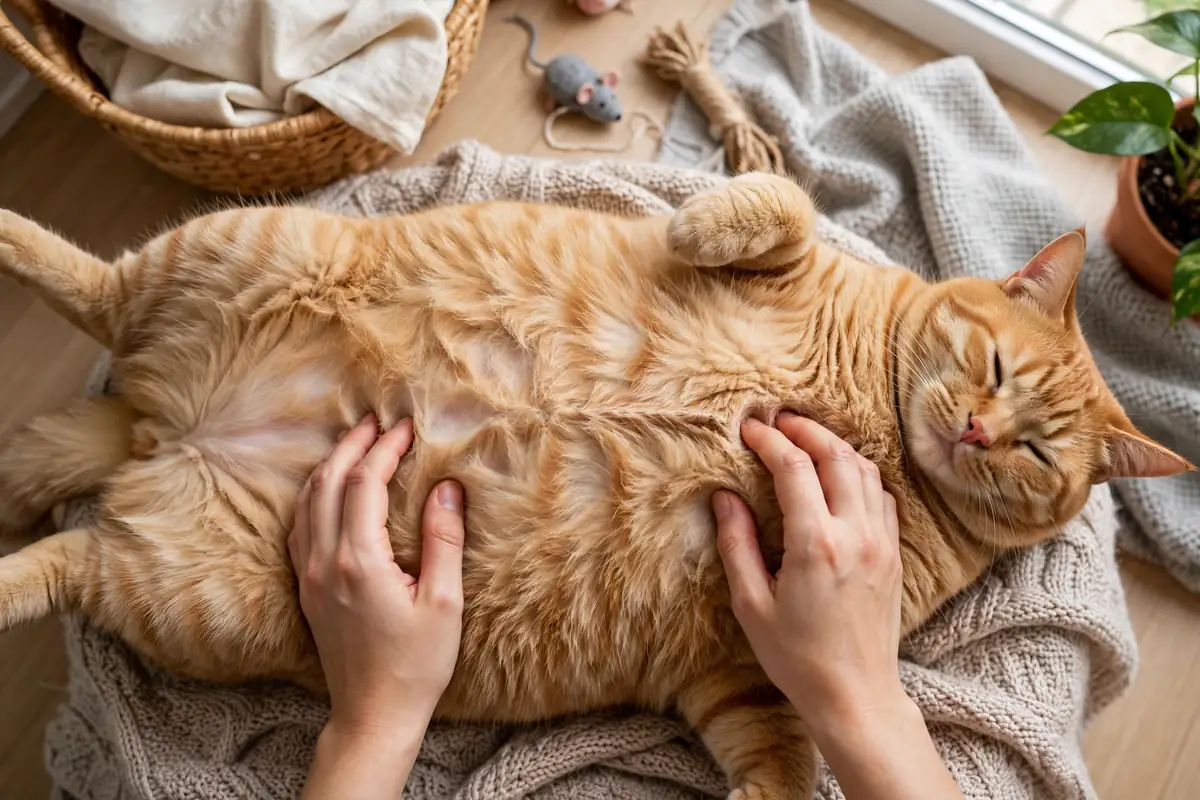
Is your cat a healthy weight — or carrying a few extra grams? More than half of pet cats are overweight, and the extra weight creeps on so slowly that many owners never notice. But even a little extra weight raises the risk of diabetes, joint pain and a shorter life.
This free checker compares your cat's weight with the ideal range for its frame size, gives a clear verdict — Underweight, Ideal, Overweight or Obese — and estimates daily calories so you know where to start. It runs entirely in your browser — nothing is sent anywhere, and nothing is stored.
🐾 Check Your Cat's Weight
Not sure? Weigh yourself holding your cat on bathroom scales, then subtract your own weight.
Your cat's weight verdict
| Ideal weight range | |
| Your cat's weight | |
| Estimated daily calories | |
| What to do next |
The verdict is a guide based on frame size, not a diagnosis. Big breeds (like Maine Coons) can be healthy above these ranges — and what your cat looks and feels like matters as much as the number on the scales.
How the Check Works
The logic is stated openly — no fake precision, just clear ranges:
- Ideal weight by frame (adult cats): Small 3–4.5 kg, Medium 3.5–5.5 kg, Large 5–7 kg.
- Kittens use a lower range (about 60% of the adult range) because they are still growing — a kitten's weight should be judged by steady growth, not an adult target.
- Verdict: below the range = Underweight; inside the range = Ideal; above the range = Overweight; more than 30% above the top of the range = Obese.
- Daily calories use the same veterinary formula as our portion calculator: RER = 70 × (weight in kg)0.75, multiplied by 2.0 for kittens, 1.2 for adults and 1.1 for seniors.
Ideal Weight Table by Frame Size
| Frame size | Ideal weight (adult) | Overweight starts above | Obese starts above |
| Small | 3–4.5 kg | 4.5 kg | 5.9 kg |
| Medium | 3.5–5.5 kg | 5.5 kg | 7.2 kg |
| Large | 5–7 kg | 7 kg | 9.1 kg |
These are guides for average mixed-breed cats. Large breeds such as Maine Coons and Norwegian Forest Cats can be healthy well above 7 kg, and petite breeds such as Singapuras can be healthy below 3 kg. If in doubt, ask your vet what range fits your cat's breed and build.
How to Check at Home: The Rib Test, Waist and Belly Tuck
Scales tell you the number — your hands and eyes tell you the condition. Do these three quick checks:
- The rib test: Run your fingers gently along your cat's ribs. You should be able to feel them easily under a thin layer of fat — like feeling knuckles through a thin glove. If you have to press hard to find them, your cat is likely overweight; if the ribs stick out sharply with no cover, your cat may be underweight.
- Waist from above: Look down at your cat from above. Behind the ribs there should be a slight inward curve — a visible waist. If the body is straight or bulges outward, that points to extra weight.
- Belly tuck from the side: Look at your cat from the side. The belly should tuck up slightly from chest to hind legs. A belly that hangs low or drags is a sign of excess weight.
If the checks and the calculator disagree, trust the checks and your vet — muscle weighs more than fat, and a stocky cat can weigh more while still being healthy.
Frequently Asked Questions
What is a healthy weight for a cat?
It depends on frame size and breed. Most adult mixed-breed house cats are healthy between about 3.5 and 5.5 kg. Small-framed cats are often healthy at 3–4.5 kg, and large-framed cats at 5–7 kg. Big breeds like Maine Coons can be healthy above 7 kg — frame matters more than the number alone.
What is cat BMI? Do cats have a BMI number like people?
Cats do not have a single BMI number like humans. Vets use a body condition score (usually 1–9) based on how the cat looks and feels — ribs, waist and belly. This checker uses the same idea in a simpler form: your cat's weight compared with the ideal range for its frame size.
How can I weigh my cat at home?
Step on bathroom scales holding your cat, note the number, then weigh yourself alone and subtract. For small kittens, a kitchen scale in a basket works well. Weigh at the same time of day, and re-check monthly so you spot slow weight gain early.
How fast should an overweight cat lose weight?
Slowly — about 1% of body weight per week, with a vet's guidance. Never starve a cat or cut food drastically: cats that stop eating can develop fatty liver disease (hepatic lipidosis), which is life-threatening. A vet-supervised plan with measured portions and daily play is the safe route.