Can Cats Eat Celery?
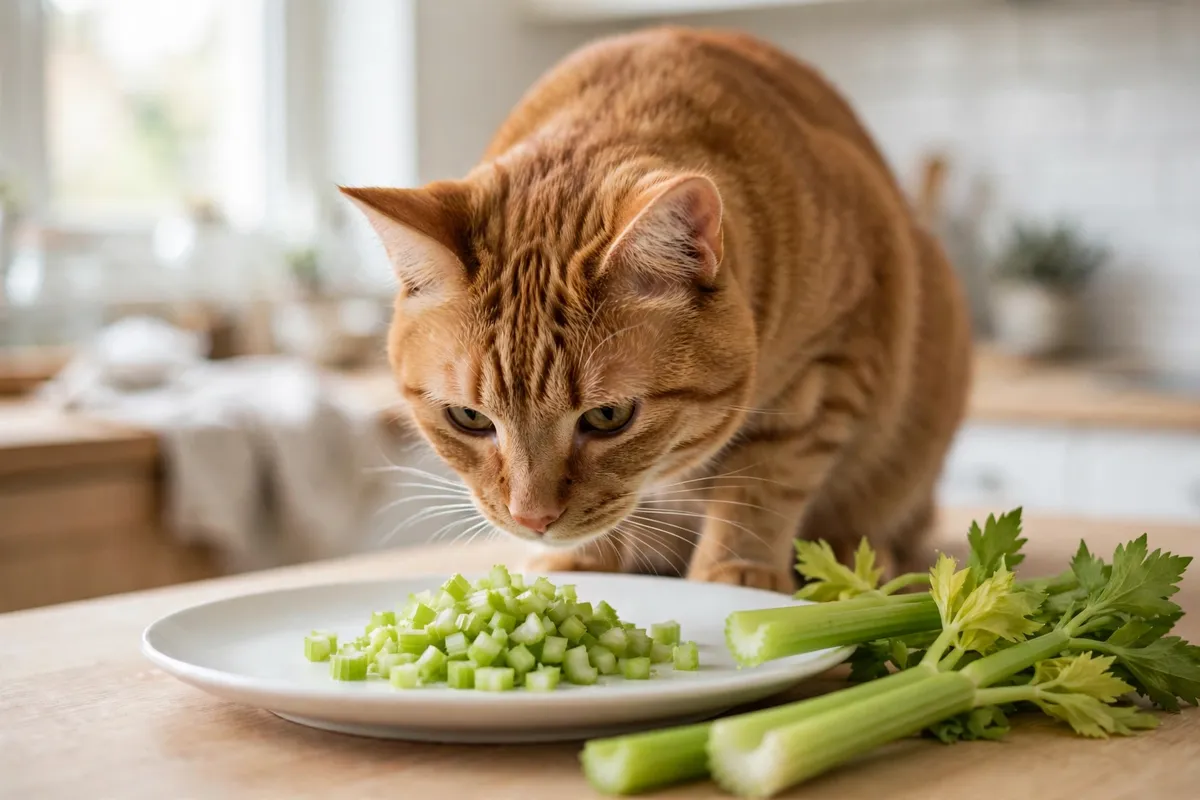
The Short Answer: Yes, But Only With the Strings Removed
Yes, cats can eat celery — but only with caution. Celery itself is not toxic, and a few tiny, well-prepared pieces are a safe occasional treat. The catch is the texture: celery is full of long, tough, stringy fibers that can catch in a cat's throat or tangle in its digestive tract. That is why celery gets a caution verdict rather than a simple yes — the strings must be peeled off and the stalk cut into pea-sized pieces first.
Celery is mostly water and fiber, so it adds almost nothing to your cat's diet — but almost no calories either. If your cat likes the crunch, a few prepared pieces are fine; if it ignores it, nothing is lost. Keep reading for the choking risk, the string-removal method, the right portion, and what to do if your cat grabs a whole stalk.
Is Celery Safe for Cats?
Celery is safe for cats in the sense that it contains nothing toxic to them. Unlike onions, garlic, grapes, and chives, it has no compounds that poison cats. It is low in calories, mostly water, and easy on the stomach in small amounts — in the same safe group as cucumber and zucchini, vegetables that are harmless when served plain and in small pieces.
But "safe" and "safe to hand over whole" are two different things. A cat's throat is narrow, and cats tend to gulp food rather than chew it. A long string can get caught going down, and a cat that swallows one whole can end up gagging or vomiting. The risk is physical, not chemical, and one minute of preparation removes it entirely — so never skip it.
Why Celery Is a Choking Hazard for Cats
The danger of celery is the string. Run your finger down a stalk and you can feel the tough fibers that run its full length. When a cat bites into a whole stalk, those fibers pull out in long strands instead of breaking into small pieces, and a swallowed strand can catch in the throat or wind through the stomach and intestines.
This is worse for cats than for people because of how cats eat. A cat does not grind food; its teeth are built for shearing, and it tends to swallow small chunks whole. A long, flexible string can wrap around the base of the tongue or stick partway down, causing gagging, retching, pawing at the mouth, or vomiting. In the worst cases, a swallowed string can cause a blockage that needs veterinary care — which is why the preparation step matters so much.
How to Prepare Celery for Your Cat
Preparing celery takes about a minute, and every step removes the string risk. Wash a fresh, crisp stalk well under running water. Then peel the strings: snap off the end and pull the fibrous threads away from the back, the way you would peel a banana. Keep pulling until the stalk feels smooth on the back.
Once the strings are gone, chop the celery into pieces no bigger than a pea — smaller is better for a first try. Serve the pieces raw and at room temperature, with nothing added: no salt, dip, peanut butter, dressing, or seasoning. Offer them in a small bowl on their own, so you can see how much your cat eats and whether it chews or swallows them whole. If your cat gulps the pieces, make them even smaller next time, or switch to a softer vegetable.
How Much Celery Can a Cat Eat?
A few pea-sized pieces — about a teaspoon — is a good serving for an adult cat, once or twice a week at most. Celery is a treat, not a food, and the ten-percent rule still applies: all treats combined should stay under ten percent of your cat's daily calories. Since celery has almost no calories, the limit is about fiber, not weight — too much raw fiber at once can loosen your cat's stool, even from a harmless food.
Start with one or two tiny pieces. Many cats will sniff celery and walk away, which is completely normal — cats are suspicious of new foods, and celery smells like almost nothing to a cat's nose. If your cat eats the pieces happily and its digestion stays normal for a day, you can offer a full small serving next time. Do not offer more just because your cat enjoys it; the string risk and the fiber load both grow with the portion.
Can Kittens Eat Celery?
Kittens can have a tiny taste of celery once they are eating solid food, usually from around eight weeks old — but only prepared exactly as for an adult cat: strings peeled away and chopped smaller than a pea. A kitten's throat is even narrower, so the choking risk is higher, and a kitten's stomach is small, so even a little extra fiber can upset it.
For kittens, one or two tiny pieces is the whole serving, and kitten food should remain the center of their diet. Celery offers a kitten nothing it needs — no protein, no fat, no essential nutrients — so there is no reason to make it a regular treat. A soft, string-free option like cooked zucchini or a tiny piece of cucumber is a gentler first choice. For kittens under eight weeks, skip vegetables entirely and stick to nursing or a kitten milk replacer as your vet advises.
What Happens If My Cat Eats Celery?
If your cat ate a few properly prepared pieces, there is nothing to worry about. Most cats digest a small serving without trouble, and the worst outcome of overdoing it is a slightly softer stool for a day. Offer fresh water, feed the next meal as normal, and skip the next vegetable treat until things settle.
If your cat grabbed a whole stalk or a long, stringy piece, watch it closely for the next few hours. Signs of trouble include gagging, retching, pawing at the mouth, drooling, repeated swallowing, or vomiting, and a partly swallowed string can make your cat keep its mouth open or act distressed. If you see any of these signs, or your cat stops eating, becomes lethargic, or cannot pass stool normally, call your vet right away — do not try to pull a string from your cat's throat yourself, as it may be caught further down than you can see. And if your cat ate celery with dip, dressing, or peanut butter, check the ingredients: dips often contain garlic or onion, which are toxic to cats, and peanut butter can contain xylitol, which is also dangerous.
Celery is safe for cats, but only with the preparation: peel the strings, chop it into pea-sized pieces, and serve it plain. A whole stalk is a choking hazard, while a few tiny, string-free pieces are a harmless occasional treat. Keep the portion small, watch the first serving, and remember that celery offers your cat almost nothing nutritionally, so there is never a reason to push it.
Can cats eat celery?
Yes, but with caution. Celery is not toxic to cats, but its tough, stringy fibers are a choking hazard. Always peel off the strings and cut it into tiny pieces before offering it.
Is celery safe for cats?
Yes, when prepared properly. Celery contains nothing toxic to cats. The risk is physical, not chemical — long strings can catch in a cat's throat or cause stomach upset.
How do I prepare celery for my cat?
Wash the stalk, peel away the tough outer strings, and chop the celery into pieces no bigger than a pea. Serve raw and plain, with no salt, dip, or dressing.
Can kittens eat celery?
Kittens can have a tiny taste of finely chopped, string-free celery once they are eating solid food, usually from around eight weeks old. Kitten food should remain their main diet.
How much celery can a cat eat?
A few pea-sized pieces, about a teaspoon, once or twice a week at most. All treats combined should stay under ten percent of your cat's daily calories.
What happens if my cat eats a whole celery stalk?
A whole stalk is a choking risk because of the long strings. Watch for gagging, retching, or vomiting, and call your vet if any of these appear.