Why Does My Cat Bite the Blanket at Night?
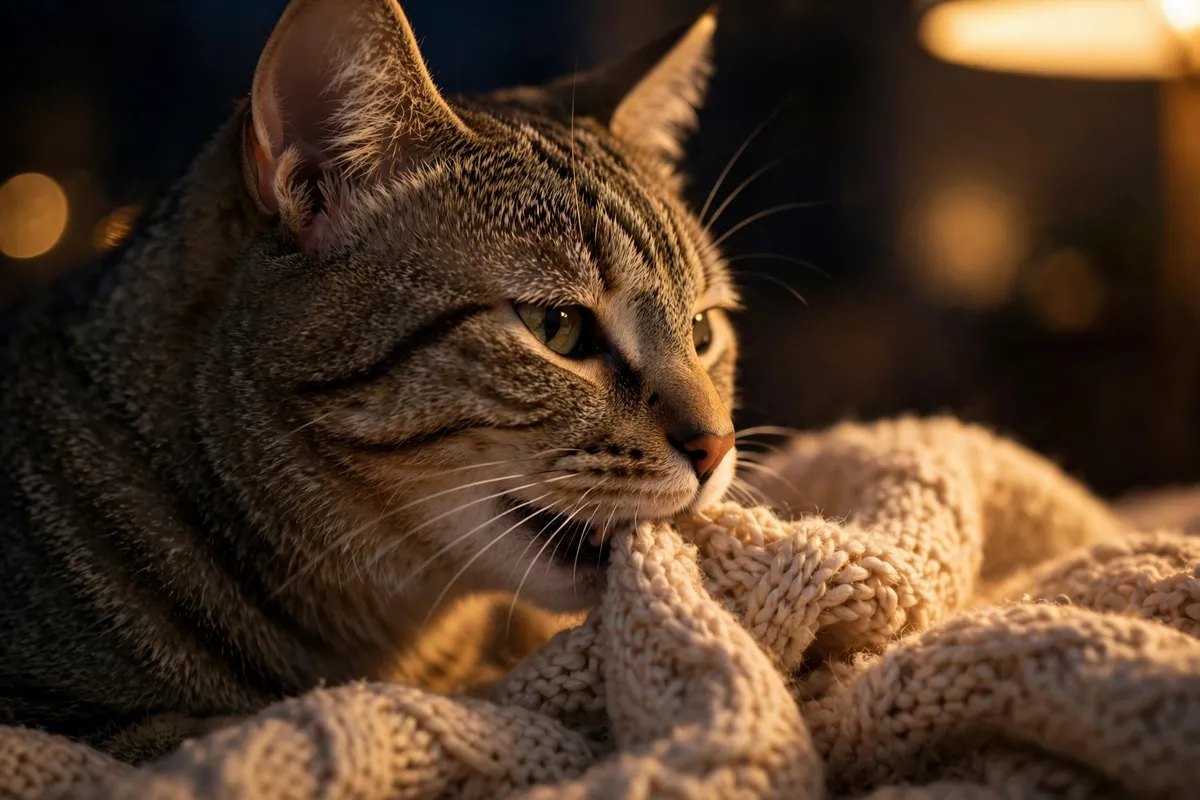
You settle into bed, lights low, and hear a familiar soft sound beside you: your cat rhythmically kneading the duvet — and now gently biting it, too. It is one of those oddly endearing cat habits that also raises an eyebrow. Why would a grown cat act like a nursing kitten, mouthing the blanket as if it were dinner?
In most cases, blanket-biting is a leftover nursing behavior. As kittens, cats kneaded their mother's belly to stimulate milk flow and mouthed at her fur while nursing. Many cats replay that soothing sequence as adults whenever they feel deeply content — and bedtime, with its warmth, quiet, and your scent nearby, is prime time. It is usually harmless, but there are a few situations where it deserves a closer look. This guide explains what is going on and how to handle it.
The Nursing Instinct: Why Adult Cats "Nurse" on Blankets
The most common explanation for blanket-biting is also the sweetest. Newborn kittens knead with their paws while nursing, and their mouths do the rest. That combination — paws pushing, mouth working — becomes deeply wired to feelings of safety, warmth, and being fed. When an adult cat kneads your blanket and starts nibbling or sucking on the fabric, it is essentially time-traveling back to that comfort.
Cats that were separated from their mothers early or weaned before about eight weeks are more likely to keep this behavior into adulthood. It is not a sign that anything went wrong with their upbringing, though — plenty of cats raised with their mothers for a full twelve weeks still do it. Think of it less as a trauma response and more as a comfort ritual, like a person twirling a lock of hair when they are relaxed.
You will often notice the full sequence: the cat settles on a soft surface, starts kneading with alternating paws, begins to purr, and then starts mouthing the fabric — sometimes sucking gently, sometimes making small chewing motions, sometimes just resting their teeth on it. Drooling can join the party too. The whole ritual releases feel-good chemistry in the cat's brain, which is why they often look half-asleep and blissful while doing it.
Wool-Sucking: Why Some Breeds Bite More Than Others
There is a particular version of this habit that behaviorists call "wool-sucking" — mouthing, sucking, and sometimes chewing on wool or other soft fabrics. It shows up most often in oriental breeds: Siamese, Burmese, Tonkinese, and their crosses. These breeds seem to carry a genetic predisposition for the behavior, and some lines do it far more than the average domestic shorthair.
Nobody knows exactly why oriental breeds are the champions of wool-sucking. One theory is that the same bold, people-focused temperament that makes these cats so interactive also makes their self-soothing behaviors more pronounced. Another is simply that the trait has been passed along in breeding lines without anyone selecting against it, since it is rarely a serious problem.
Despite the name, wool-sucking is not limited to wool. Cats do it with fleece throws, knitted blankets, sweaters, stuffed toys, and occasionally their owner's hair or earlobes. Soft, textured fabrics seem to be the biggest trigger — something about the mouthfeel resembles the mother cat's fur. If your Siamese is obsessed with one particular throw, this breed tendency is the likely explanation.
Why It Happens at Night: Comfort, Warmth, and Routine
So why does your cat save this performance for bedtime? Nighttime is when the conditions for self-soothing are perfect. The house is quiet, the lights are low, and you — the cat's favorite warm object — are lying still for hours. Cats are creatures of ritual, and many build a whole wind-down routine: patrol the house, use the litter box, have a late snack, then claim their spot on the bed for kneading and nibbling.
Warmth plays a big role. A bed that has been holding your body heat for a while is irresistibly cozy, and the blanket itself traps that warmth. The scent matters too — your bedding smells like you, and for a bonded cat, your scent is calming. Biting and sucking on the blanket while surrounded by your smell is about as secure as a cat can feel.
There is also a simple practical reason: at night you are a captive audience. Many cats learn that the knead-and-nibble routine earns gentle stroking or at least a warm lap to lie on. If you tend to pet your cat while they do it, you have been quietly rewarding the behavior — which is perfectly fine, as long as everyone is happy.
Stress and Boredom Can Turn Nibbling Into a Habit
Comfort is the usual story, but blanket-biting can also be a coping mechanism. Cats that are anxious, understimulated, or unsettled by change sometimes increase their mouthing behavior. A new schedule that leaves the cat alone longer, a recent move, a new pet, construction noise — any of these can push a cat toward more self-soothing.
The clue is in the pattern. A cat that has always nibbled the blanket at bedtime and seems relaxed while doing it is almost certainly fine. A cat that suddenly starts chewing fabric obsessively, does it frantically rather than sleepily, or pairs it with other changes — hiding, appetite shifts, over-grooming, avoiding the litter box — is telling you something changed in their world.
Boredom deserves special mention. Indoor cats with too little play and mental stimulation sometimes redirect their energy into repetitive mouth behaviors. If your cat's blanket sessions have ramped up and the evenings have gotten quieter around your house, the fix might be as simple as a good interactive play session before bed — a wand toy "hunt" followed by a small meal mirrors the natural hunt-eat-groom-sleep cycle and can genuinely reduce nighttime mouthing.
Pica Warning: When Blanket-Biting Becomes Dangerous
Here is where you need to pay attention. There is a big difference between mouthing fabric and eating it. Gentle sucking or nibbling that leaves the blanket intact is harmless. But if your cat is tearing off pieces and swallowing them, that crosses into pica — the compulsive eating of non-food items — and it can be genuinely dangerous.
Swallowed fabric does not digest. In the best case it passes through; in the worst case it causes a gastrointestinal blockage, which is a veterinary emergency that can require surgery. Warning signs include vomiting (especially repeated vomiting), loss of appetite, lethargy, abdominal discomfort, straining in the litter box, or finding chewed holes in blankets with pieces missing.
Some cats are drawn to specific materials — elastic, string, and yarn are classic blockage culprits, and cats that chew those should be redirected firmly and the items stored away. If your cat's blanket-biting has escalated to actual ingestion, call your veterinarian. Do not wait to see if it passes, and never try to pull a string or fabric thread from your cat's mouth or rear — it can be anchored internally, and pulling can cause serious damage.
How to Redirect Blanket-Biting Safely
For the vast majority of cats, blanket-biting needs no "fix" at all — it is a harmless comfort behavior. But if your cat is destroying your favorite throw or you simply want to channel the habit, here is how to do it kindly:
- Give them their own blanket. Designate one soft throw as the cat's nursing blanket and place it on their favorite sleeping spot. Many cats happily transfer the ritual to "their" blanket and leave yours alone.
- Redirect, don't punish. Scolding or pushing a cat away from a self-soothing behavior creates stress — the opposite of what you want. Calmly move their own blanket under them, or offer a soft toy to mouth instead.
- Offer safe chew alternatives. Some cats like silvervine sticks or cat-safe chew toys. A stuffed kicker toy can give mouthy cats something appropriate to grab and gnaw.
- Increase evening enrichment. A solid play session before bed burns off restless energy. Puzzle feeders also give mouth-oriented cats a constructive outlet.
- Protect the fabrics that matter. Keep cherished or delicate blankets out of reach at night, and avoid leaving yarn, string, or elastic bands where a mouthy cat can find them.
- Keep the routine steady. Since nighttime mouthing is tied to security, a predictable bedtime routine — same play, same feeding time, same sleeping spot — keeps the ritual in the "comfort" zone rather than the "coping" zone.
And if the blanket-biting ever shifts from gentle to compulsive, or your cat starts swallowing material, that is your cue to involve your veterinarian. Most of the time, though, that soft nibbling beside you at night is simply your cat saying, in the oldest language they know, that they feel safe.
Frequently Asked Questions
Why does my cat knead and bite the blanket at the same time?
Kneading and blanket-biting usually go together because both come from kitten nursing behavior. Kneading stimulated milk flow from the mother, and the mouthing mimics nursing — adult cats replay the whole soothing sequence when they feel content.
Is it normal for an adult cat to suck on blankets?
Yes, it is common and usually harmless. Many adult cats keep this comfort behavior for life, especially if they were weaned early or belong to oriental breeds. It only becomes a concern if the cat starts swallowing fabric or the habit appears suddenly alongside other behavior changes.
How do I stop my cat from chewing holes in my blanket?
Give your cat a designated blanket of their own, redirect with a safe chew toy when they start on yours, and make sure they get enough playtime and enrichment. Never punish the behavior — it is self-soothing. If they are actually eating fabric, see your vet.
Can blanket-biting be a sign of stress in cats?
It can be. A sudden increase in blanket-chewing, especially in an older cat, may signal stress, boredom, or anxiety triggered by changes like a move, a new pet, or a disrupted routine. Watch for companion signs such as hiding, appetite changes, or over-grooming.
When should I worry about my cat biting fabric?
Worry when your cat swallows pieces of fabric, vomits, loses appetite, or strains in the litter box — these can indicate a gastrointestinal blockage. Also consult your vet if the behavior starts suddenly, becomes compulsive, or involves non-fabric objects too.