Why Does My Cat Chatter at Birds?
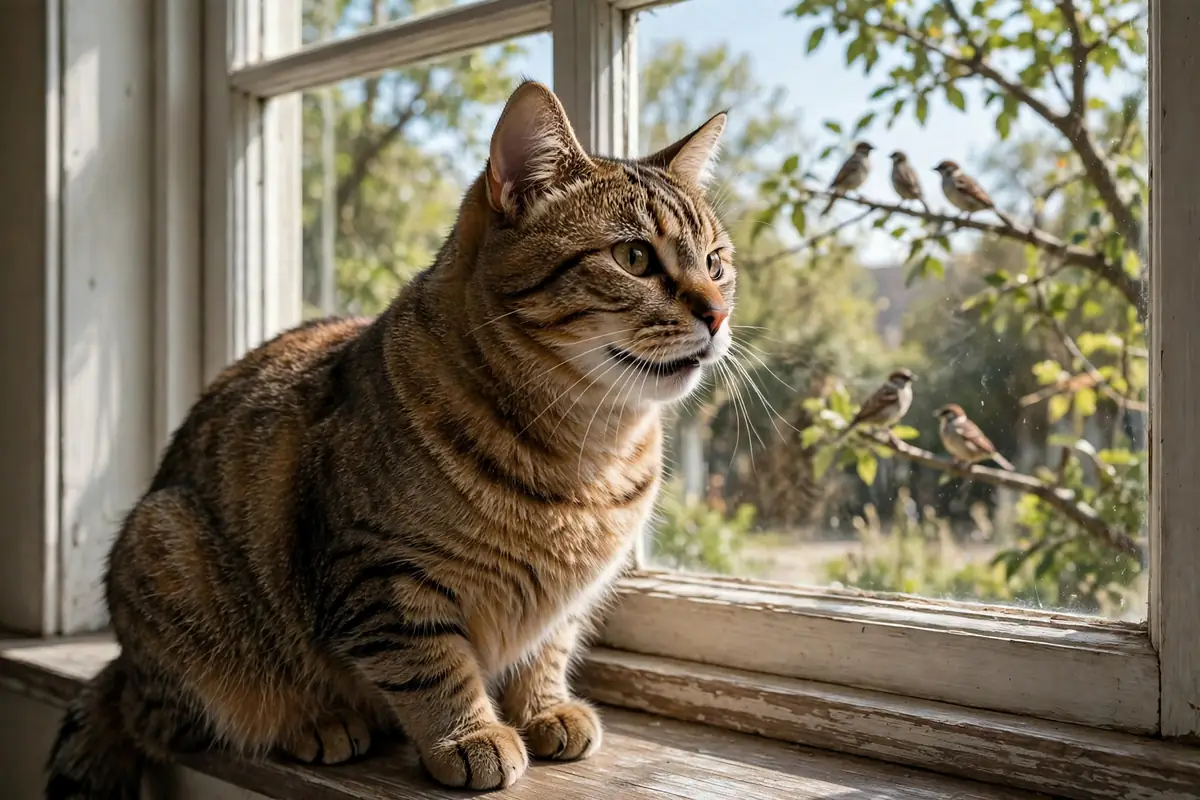
Cat chattering — that rapid, jaw-clicking "ek-ek-ek" sound your cat makes while locked onto a bird — is a burst of pure hunting excitement. The leading theory is that it's an involuntary reaction to seeing unreachable prey: your cat's brain fires up the entire hunting sequence, and the jaw quivers in anticipation, almost as if rehearsing the killing bite it can't deliver through the glass.
Whatever the exact mechanism, chattering is completely normal — and it's not a sign of unhappiness. In fact, it usually means your cat is mentally engaged and stimulated. It happens most often at windows, where birds, squirrels, and bugs parade just out of reach. This guide breaks down the main theories behind chattering, what it says about your cat's mood, how to feed that hunting drive with enrichment, and the related chirps and trills you'll hear along the way.
What Does Cat Chattering Sound Like?
If you've never heard it, chattering is unmistakable once you do: a fast, staccato clicking or quivering of the jaw, sometimes described as "ekekek" or a muted machine-gun rattle. The mouth may hang slightly open, the body goes rigid with focus, the tail often flicks at the tip, and the eyes stay glued to the target. Episodes usually last only seconds to a minute — just long enough for the bird to fly away — and many cats add a frustrated little chirp at the end for good measure.
4 Theories About Why Cats Chatter at Birds
Researchers and behaviorists haven't settled on a single explanation, but four theories dominate the conversation:
1. Frustration at unreachable prey
The most popular theory says chattering is the sound of thwarted instinct. Your cat sees prey, the hunting sequence activates — stalk, chase, pounce, bite — and then the window glass slams the sequence shut. The jaw-quivering is thought to be frustration leaking out: all that predatory energy with nowhere to go. It's the feline equivalent of a sports fan shouting at the TV.
2. Rehearsing the killing bite
A second theory holds that the jaw movement is instinctive "practice" for the killing bite — the precise neck bite cats use to dispatch prey quickly. Some behaviorists suggest the rapid opening and closing mimics the motion cats make when subduing small prey. Under this view, chattering isn't frustration at all; it's the hunting program running on autopilot, complete with the finishing move.
3. Pure excitement overload
A simpler take: chattering is just what extreme excitement looks like in a cat. Adrenaline spikes, muscles tense, and the jaw trembles the way a person's hands might shake before a big moment. Cats who chatter tend to be the most bird-obsessed, high-drive hunters of the household — the behavior correlates with enthusiasm, not distress.
4. Mimicry or communication
The wildest theory suggests cats may be attempting to mimic bird or insect sounds to lure prey closer — a trick some wild cats are believed to use. Others propose it's social: a way of "talking about" prey, similar to the chirps mother cats use to call kittens. The evidence here is thin, but it's a fun reminder that we still don't fully understand everything our cats are saying.
Why Indoor Cats Do It at the Window
For indoor cats, the window is prime-time television — and birds are the main characters. Chattering happens most at windows for a simple reason: that's where prey appears regularly but can never be reached, creating the perfect conditions for the theories above. The combination of movement, bird calls, and visual tracking sends the hunting brain into overdrive.
This is worth celebrating, not fixing. A cat who chatters at the window is a cat whose instincts are alive and well. The behavior only becomes a concern in the rare case where it's paired with genuine distress — pacing, yowling, or aggression toward other pets after "losing" the bird. For the vast majority of cats, it's a few seconds of drama and then back to the nap.
Does Chattering Mean My Cat Is Unhappy?
No — and this is the question owners ask most. Chattering looks intense, so it's natural to wonder whether your cat is miserable staring at a world they can't touch. But behaviorists read it the opposite way: a chattering cat is an engaged cat. The hunting sequence is the most mentally stimulating thing a cat's brain does, and even a "failed" hunt through glass provides enrichment.
The distinction that matters is frustration versus distress. Brief chattering followed by normal behavior — grooming, napping, playing — is healthy stimulation. What's not healthy is a cat who fixates for hours, can't be distracted, or redirects aggression onto you or another pet. If you see that pattern, the answer isn't to block the window; it's to give the hunting drive a better outlet, which is exactly what the next section covers. You'll find more on reading feline moods in our Cat Behavior guides.
6 Ways to Enrich Your Cat's Hunting Drive
Rather than trying to stop the chattering, feed the instinct behind it:
- Set up a window bird feeder. A feeder suction-cupped to the outside of the window turns chattering sessions into front-row entertainment — the single best enrichment upgrade for a bird-obsessed cat.
- Schedule daily play sessions. Two or three 10-minute sessions with a wand toy that mimics bird or mouse movement let your cat complete the full hunt-catch-"kill" cycle that the window denies them. Always end with a small treat or meal — the "catch" needs a payoff.
- Use puzzle feeders. Food puzzles engage the same problem-solving circuits as hunting and are perfect for the hours you're away.
- Rotate toys weekly. A "new" toy every few days keeps the novelty that prey provides. Even a paper bag or cardboard box counts.
- Give them a window perch. A sturdy cat tree or hammock by the favorite window makes bird-watching comfortable and claims the territory as theirs.
- Try supervised outdoor time. A secure catio, a cat-proofed balcony, or harness walks let your cat experience real sights and smells safely — and keep local wildlife safe too.
Here at Purrfect Paws, we think of chattering as a request: your cat is telling you the hunter inside is awake. Answer it with play, not punishment.
Chattering's Cousins: Chirps, Trills, and Other Hunting Sounds
Chattering isn't your cat's only prey-related vocalization. Listen closely and you'll hear a whole hunting vocabulary:
- Chirps: short, bird-like "brrp!" sounds, often directed at you when your cat wants you to follow them — or at prey, possibly as an excitement overflow.
- Trills: the rolling "prrrp" greeting cats use with kittens and favorite humans; mother cats use it to say "follow me," and some cats trill mid-hunt too.
- Chattering vs. growling: don't confuse the jaw-click of chattering with the low warning growl of an irritated cat — the body language is opposite. Chattering comes with forward focus and excitement; growling comes with flattened ears and tension.
Learning these sounds is one of the great joys of living with cats — each one is a small window into how their wild instincts survived the move to your sofa.
Frequently Asked Questions
Is cat chattering normal behavior?
Completely. Chattering is a normal, instinctive response seen in cats of all ages and breeds when they spot prey they cannot reach — usually birds outside a window. It is a sign of an engaged, stimulated cat, not a problem to fix.
Do cats only chatter at birds?
No — birds are just the most common trigger. Cats chatter at squirrels, chipmunks, insects, falling leaves, and even prey on television screens. Any small, fast-moving, unreachable target can set it off.
Why does my cat's jaw quiver when chattering?
Nobody knows for certain, but the leading theories say the jaw movement is either frustration at unreachable prey or an instinctive rehearsal of the killing bite. Either way, it is an involuntary response driven by the hunting sequence firing in your cat's brain.
Should I let my cat outside to catch birds?
It is kinder — to both your cat and wildlife — to keep the hunting indoors. Outdoor cats face traffic, predators, disease, and parasites, and free-roaming cats kill large numbers of wild birds each year. A window feeder, daily wand-toy play, and puzzle feeders satisfy the same instincts safely.
My cat never chatters — is something wrong?
Not at all. Not every cat chatters; it is a personality and prey-drive thing. Some cats watch birds in total silence, others chirp or trill instead, and some could not care less about birds. All of these are perfectly normal variations.