Why Does My Cat Sit on High Places?
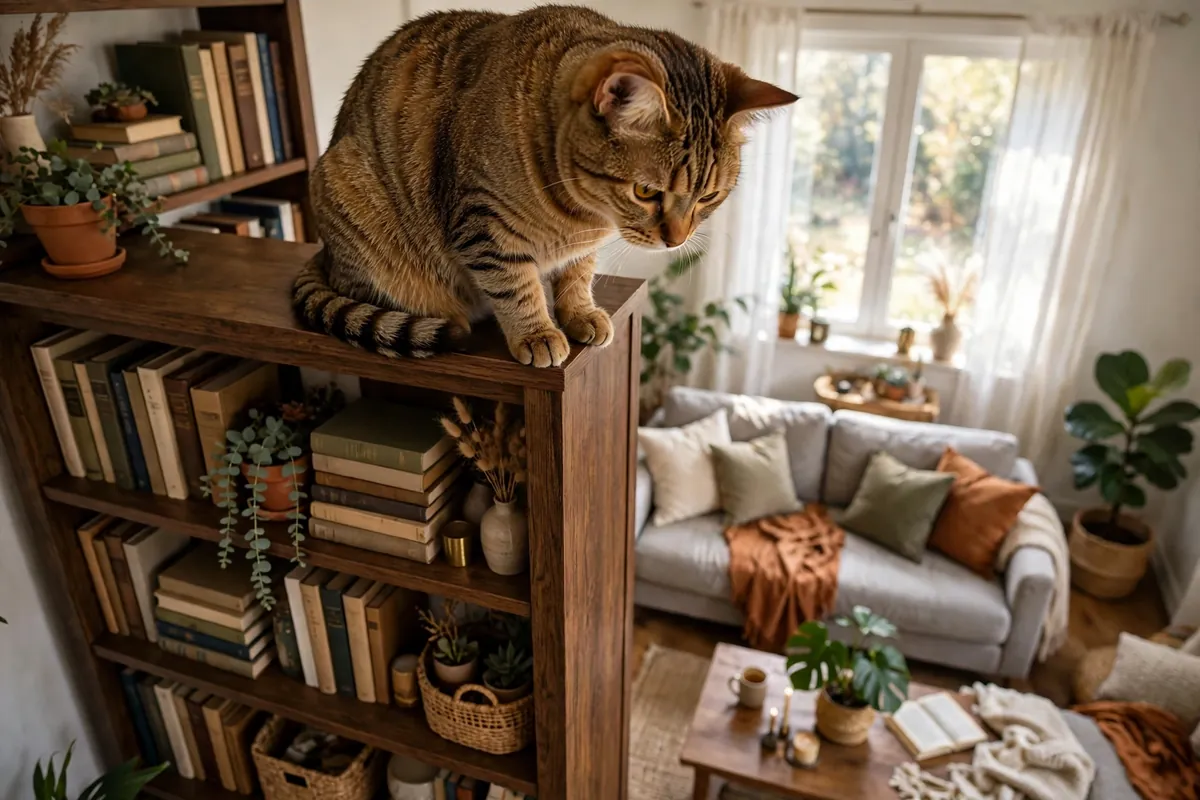
If you have ever looked up to find your cat balanced on top of a bookshelf, a wardrobe, or the fridge, staring down at you like a tiny supervisor, you have seen one of the most deeply wired cat behaviors there is. Cats are climbers by nature, and high places are not a quirk or a show of defiance. They are how cats understand their territory, stay safe, and feel in control of their world.
A cat on a high perch can see the whole room, watch for anything approaching, and rest without worrying about being surprised. For a shy cat, height is confidence. For a confident cat, height is simply the best seat in the house. This guide explains the instinct behind it, what your cat gains from high places, and how to set up safe shelves and perches, even in a small home.
Why Do Cats Sit on High Places?
Cats sit on high places because height gives them three things at once: a full view of their surroundings, a feeling of safety, and a sense of ownership over their territory. From a high perch, a cat can see who is coming, where the other pets are, and where the best sunny spot will be later. Nothing can sneak up from behind, and the cat can choose when to come down and interact.
This is not a learned habit or a sign of a spoiled cat. It is an instinct that comes from a cat's wild ancestors, which climbed trees to hunt, rest, and escape danger. Even a cat that has never been outside feels the same pull toward the highest available spot. If your cat is always on top of something, it is not being difficult. It is being a cat, and it is telling you that vertical space matters as much to it as floor space does to you.
Vertical Territory: How Cats See the World
People think of territory in square feet, but cats think in cubic feet. To a cat, the space above the furniture is just as much territory as the floor, and a home with no vertical options feels small and boring, no matter how big the rooms are. A cat that can move up and down, from the floor to a shelf to the top of a wardrobe, experiences its home as a much larger and richer place.
Vertical territory also helps cats share a home peacefully. In a multi-cat household, a high perch lets one cat rest above the other without a confrontation, and it gives each cat a way to avoid the other without leaving the room. If your cats argue over the same sunny spot, adding a second high perch often ends the argument, because the real argument was never about the spot. It was about having a place of their own.
Safety Instinct: The View From Above
For a cat, a high place is a safe place. Small animals that live on the ground are vulnerable to surprise, and a cat's answer to that vulnerability is to get up high, where it can see everything and nothing can approach unnoticed. A cat on top of a bookshelf is not hiding. It is watching, relaxed, and in control, and that feeling of control is deeply calming for a prey animal that is also a predator.
This is why shy and newly adopted cats often head straight for the top of a wardrobe or the highest shelf they can reach. Height gives them time to watch their new home and its people from a safe distance, and to come down when they feel ready. Forcing a shy cat down from a high perch usually backfires, because it takes away the one thing that makes the cat feel safe. Let the cat keep its lookout post, and it will come down on its own terms.
High Places and Confidence in Shy Cats
If you have a nervous or shy cat, vertical space is one of the best tools you have. A cat that can climb up to a perch when the vacuum cleaner starts, when visitors arrive, or when a dog walks past, can cope with stress instead of panicking. The perch becomes a retreat, and the cat learns that it can always escape upward, which makes the whole house feel safer, even on the floor.
Watch how your shy cat uses height. A cat that eats on the floor but sleeps on a high shelf is telling you that it feels safe enough to come down for food, but still wants a secure place to rest. Over time, as the cat grows more confident, you will often see it spending more time at lower heights and in the open. The high perch did not make the cat shy. It gave the cat the security it needed to become brave.
Setting Up Shelves and Perches in a Small Home
You do not need a big house to give your cat vertical territory. A few sturdy wall shelves, arranged like steps, can turn a small living room into a climbing playground. Place the shelves near a window so your cat gets a view, and add a soft blanket or a small bed on the highest shelf so it becomes a resting spot, not just a walkway. Make sure every shelf is fixed firmly to the wall with proper anchors, because a shelf that wobbles will teach your cat not to trust it.
Other easy options include a tall cat tree in a corner, a window perch that attaches with suction cups, and clearing the top of a sturdy bookshelf or wardrobe so your cat can use it safely. In a small home, the space above a door, a radiator cover, or a low cabinet can become a perch too. The key is a route: cats want to get up and down without jumping from a great height, so leave a step or a piece of furniture in between. A cat that can climb up easily will use its perch every day.
When High-Perch Habits Change
A cat that loves high places and suddenly stops climbing is worth a closer look. Cats that used to sleep on top of the wardrobe and now stay on the floor may be dealing with arthritis, a sore leg, or a painful tooth that makes jumping uncomfortable. Older cats in particular can lose confidence in their jumping as their joints stiffen, and they may stop using high perches quietly, without any obvious limp.
On the other hand, a cat that suddenly starts hiding on high places all day, refusing to come down for food or play, may be stressed or unwell. The difference is in the pattern: a cat that climbs less because it hurts needs a vet check and easier routes, such as ramps or steps to its favorite perch. A cat that hides more than usual needs a look at what has changed in the home, and a vet visit if the behavior comes with appetite or litter box changes. Height is a window into how your cat feels, so notice when the pattern changes.
Frequently Asked Questions
Why does my cat sit on top of the fridge?
The top of the fridge is high, warm, and has a full view of the kitchen, which is everything a cat wants in a perch. It is also one of the tallest spots in the room. If the fridge top is safe and clear, it is a normal and harmless favorite.
Do cats like high places because they feel safe?
Yes. From a high place a cat can see the whole room, nothing can approach unnoticed, and the cat can rest without worrying about being surprised. Height gives cats a feeling of control, which is especially important for shy or newly adopted cats.
How can I give my cat high places in a small apartment?
Use wall shelves arranged like steps, a tall cat tree in a corner, or a window perch. Clear the top of a sturdy bookshelf or wardrobe for your cat to use. The key is a safe route up and down, with a step in between, so your cat can climb without a big jump.
Is it normal for cats to sit on top of door frames?
Yes, door frames are a classic cat perch. They are high, narrow, and give a great view down a hallway. Cats that sit on door frames are usually just enjoying the vantage point. Make sure the frame is sturdy and the cat has a safe way down.
Why has my cat stopped climbing to high places?
A sudden stop in climbing can mean pain, often arthritis or a sore leg, especially in older cats. It can also mean stress or illness if the cat is hiding more than usual. If the change is sudden or comes with appetite or litter box changes, book a vet visit.