Why Does My Cat Sleep on My Head?
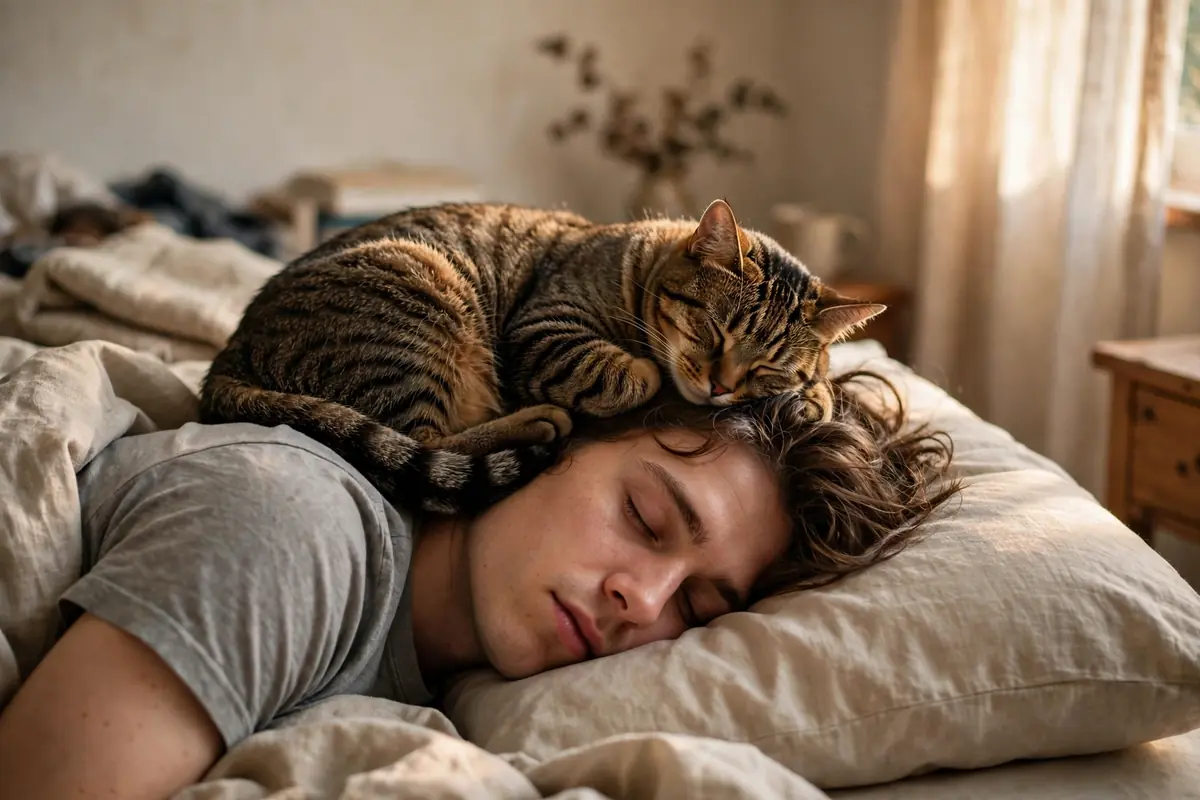
If your cat has ever chosen your head as their personal pillow, congratulations — you have been claimed. Cats sleep on heads for a simple, flattering set of reasons: your head is one of the warmest spots on your body, it carries your familiar scent, it is the highest and safest perch on the bed, and curling up there lets your cat blend their scent with yours, quietly marking you as part of their territory. In cat language, that is one of the highest compliments you can receive.
It can also be mildly annoying — the hair in your mouth, the 4 a.m. kneading session on your scalp, the way they somehow always pick your pillow and never your partner's. This guide explains the six real reasons cats do it, when the habit is perfectly fine, when to keep an eye on it, and how to gently redirect your cat if you would rather keep your pillow to yourself.
The 6 Reasons Your Cat Sleeps on Your Head
1. Warmth, warmth, warmth
Cats run warmer than we do — a healthy cat's body temperature sits around 100.5°F to 102.5°F — and they are relentless seekers of cozy heat. Your head is one of the few parts of your body that stays uncovered above the blankets all night, radiating steady warmth straight into the cool bedroom air. To a cat doing their nightly real-estate survey of the bed, your head is basically a heated mattress with a pulse. This is also why the habit often gets worse in winter: when the house cools down, you become the warmest object in the room.
2. Your scent is their comfort blanket
Cats experience the world primarily through smell, and familiar scents mean safety. Your pillow and hair hold a concentrated dose of you — the person who feeds them, pets them, and keeps the scary vacuum cleaner at bay. Curling up on your head surrounds your cat in that scent cocoon all night long. It is the same reason cats love sleeping on your freshly worn laundry: your smell signals home, and home signals safety.
3. The highest point feels the safest
Deep in a cat's instincts, height equals safety. Wild cats rest in elevated spots where predators cannot easily reach them, and that programming never left the house cat. When you lie flat, your head becomes the highest point of your sleeping body — prime real estate. A cat perched on your head has a 360-degree view of the room and the satisfying knowledge that nothing can sneak up from behind. Your feet, by contrast, twitch and kick all night. Your head wins.
4. They are marking you as theirs
Cats carry scent glands on their cheeks, chin, and forehead. When your cat rubs their face against your head and settles in, they are depositing facial pheromones — a chemical signature that essentially labels you "mine." Sleeping on your head takes it a step further: hours of contact thoroughly mixes their scent with yours. Far from being rude, this is your cat filing you under "family." You do not own the cat; the cat has graciously decided to own you.
5. Routine and habit
Cats are creatures of deep routine, and once a sleeping spot works, it becomes the spot. If your cat tried your head once on a cold night and it was warm, safe, and smelled like you, that single success was enough to write it into the nightly schedule. Cats do not rethink working systems — expect your cat to march to the same pillow at roughly the same time every evening, with the confidence of a commuter who has taken the same train for years.
6. Affection and trust
Sleep is when a cat is at their most vulnerable, so where they choose to sleep is one of the most honest things they tell you. A cat that drapes themselves across your head is saying they feel completely safe with you — close to your warmth, your scent, and the steady sound of your breathing. Not every cat shows love this way (some prefer the foot of the bed, and that is fine too), but head-sleeping is about as strong a trust signal as cats give.
Is It Safe? What to Watch For
For most healthy adults, a cat sleeping on your head is harmless — more of a lifestyle quirk than a health concern. Still, there are a few situations worth keeping in mind:
- Allergies and asthma. A faceful of dander all night can trigger sneezing, itchy eyes, or wheezing. If your symptoms flare after your cat takes up the head-pillow habit, the two are probably connected — talk to your doctor and consider redirecting the cat to a spot beside your pillow instead.
- Babies and small children. Cats should never sleep in cribs or on top of newborns. A cat seeking warmth does not understand that a tiny baby cannot push them away, so keep the nursery door closed or use a crib net.
- Very young kittens. A tiny kitten can get squished under a sleeping adult's head. Give kittens their own snug bed nearby until they are bigger.
- Cleanliness. Cats that roam outdoors can bring fleas, ticks, or litter-box residue into your bed. Keep flea prevention up to date and change your pillowcase regularly — your vet can advise on the right parasite protection.
- Sudden behavior changes. If a cat that never slept on you suddenly becomes clingy and shows other changes — hiding, appetite loss, lethargy — the clinginess may be a sign they feel unwell. A vet check is the safe move, and our Purrfect Paws health guides can help you spot warning signs early.
What If You Don't Want the Cat on Your Head? (Gentle Alternatives)
Here is the golden rule: never punish your cat for this. From their perspective, they are paying you the highest compliment — scolding or shoving them off teaches them that closeness gets punished, which damages trust. Instead, make another spot more appealing than your head:
- Set up a decoy pillow. Place a spare pillow right beside yours, topped with a worn t-shirt that smells like you. Many cats accept "next to your head" as a perfectly fine substitute for "on your head."
- Offer a heated bed nearby. A self-warming cat bed on the nightstand competes directly with your head's main selling point: heat. Put it within arm's reach so your cat still feels close to you.
- Play before bed. A 10–15 minute interactive play session (wand toy, crinkle ball) followed by a small meal mimics the hunt-eat-groom-sleep cycle. A pleasantly tired cat is more likely to curl up and stay put.
- Be consistent. Gently move your cat to the alternative spot every single time, with a calm voice and a treat or chin scratch as a reward for staying there. Inconsistent rules just teach persistence.
- If you close the door, do it kindly. Some people simply need a cat-free bedroom for sleep or allergies. That is okay — but give your cat cozy bedding, a nightlight, and maybe a timed feeder with a small midnight snack so the closed door does not feel like exile.
Most cats adjust within a week or two. And if you secretly enjoy the warm little hat? There is no rule that says you have to change a thing — many cat parents consider it the best part of bedtime. You can explore more endearing feline quirks in our Cat Behavior guides.
Frequently Asked Questions
Is it safe for my cat to sleep on my head?
For healthy adults, yes — it is generally harmless. The main exceptions are people with cat allergies or asthma (dander right by your face can trigger symptoms), and households with newborn babies, where cats should always be kept out of cribs. Very young kittens could also get squished, so give tiny kittens their own cozy bed instead.
Does my cat sleeping on my head mean they love me?
It is one of the strongest trust signals a cat can give. Sleep is when a cat is most vulnerable, so choosing your head — close to your scent, warmth, and heartbeat — shows deep comfort and attachment. It is affection in cat language, even if it occasionally comes with hair in your mouth.
Why does my cat only sleep on my head in winter?
Because warmth is the number one reason. Cats run warmer than humans and constantly seek cozy heat sources. In cold months your head — exposed above the blankets and radiating heat all night — becomes the warmest, most appealing spot in the house.
Why does my cat knead my head while falling asleep?
Kneading is a leftover nursing behavior from kittenhood, and adult cats do it when they feel deeply content and safe. Kneading your scalp means your cat is settling into maximum comfort mode. Keep their nails trimmed and you can gently redirect the paws to a blanket if it gets scratchy.
How can I stop my cat from sleeping on my head without hurting their feelings?
Never punish them — just offer something better. Place a warm, cozy cat bed (or a pillow with your worn t-shirt on it) right beside your pillow, play with your cat before bed so they are pleasantly tired, and be consistent. Most cats happily accept a comfy alternative that is close to you without being on you.