Why Does My Cat Sleep on My Pillow?
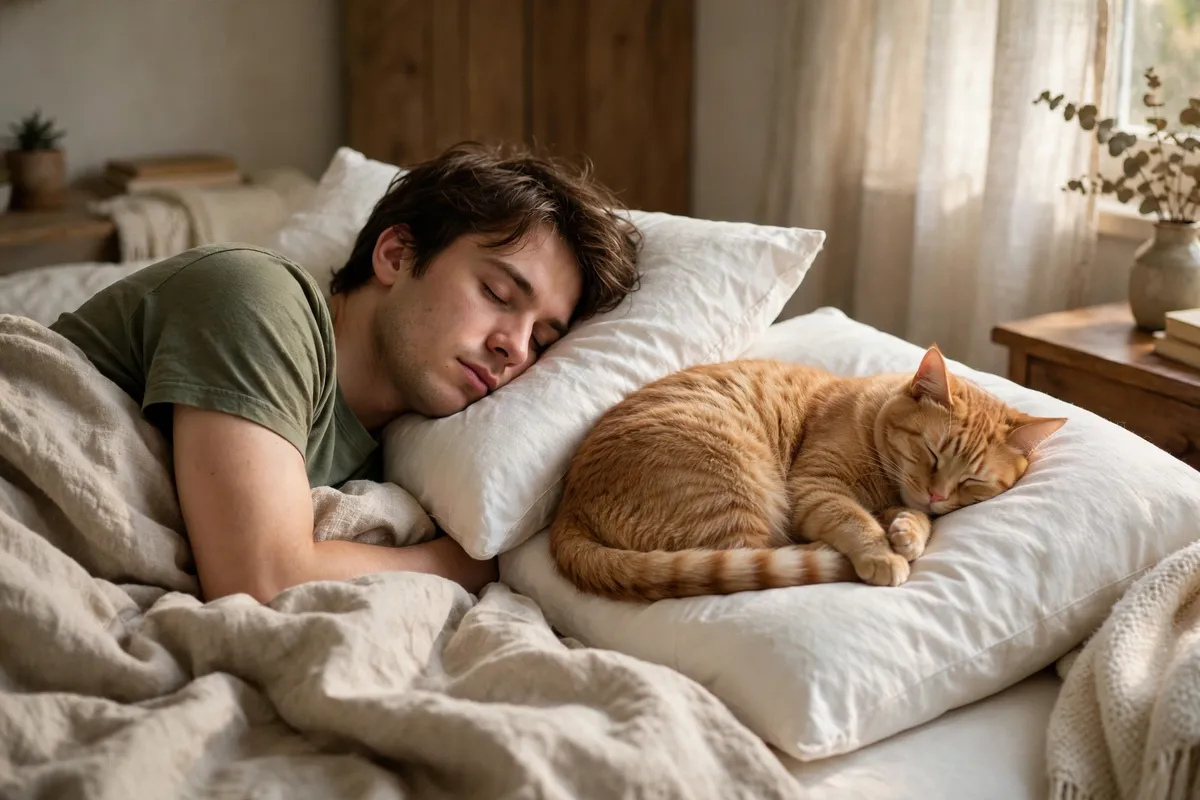
You go to bed, and there it is: your cat, curled in the exact center of your pillow, fast asleep, looking completely unbothered by the fact that you now have nowhere to put your head. Some cats claim the pillow every night, others only on cold nights, and a few will settle for the pillow's edge, as close to your face as they can get without technically being on it.
It is not random, and it is not spite. Cats choose sleeping spots for warmth, scent, safety, and companionship, and your pillow happens to score highly on all four. Here is what your pillow offers your cat, what it means about your bond, and how to share the bed on terms that let you both sleep.
Warmth: The Simplest Reason
Cats run warmer than humans — a normal cat body temperature is around 101 to 102.5 degrees Fahrenheit — and they love warm, insulated spots. Your pillow holds the warmth of your head and your breath all night, and it sits on a bed that is already warm from your body. For a cat, a pillow is essentially a pre-heated sleeping pad, and on a cold night it beats every other spot in the house.
This is also why pillow sleeping increases in winter and why cats often migrate to the pillow after you have been lying there a while. If your cat only claims the pillow on cold nights, warmth is almost certainly the main driver, and a heated cat bed or a warm blanket near your bed can be a surprisingly effective alternative.
Your Scent Is Comfort
Your pillow carries the strongest concentration of your scent in the house: your hair, your skin, hours of breathing. To a cat, scent is identity and safety, and sleeping on the thing that smells most like you is deeply reassuring. This is especially true for cats that are bonded to one person — the pillow is, in scent terms, you, even when you are not in the room yet.
It also works in reverse: your cat is adding its scent to your pillow by sleeping on it, kneading it, and rubbing its face on it. Cats mark the things they consider theirs with cheek glands, and your pillow is prime territory. That scent exchange is a big part of how cats maintain their bond with their people — it is the feline version of leaving a sweater at a partner's house.
Safety and the View From the Top
Sleeping at the head of the bed, slightly elevated, gives a cat a good view of the room and the door, and a quick escape route. Cats are most vulnerable when asleep, so they choose spots where they can sense danger early and leave fast. The pillow, at the top of the bed and near a wall or headboard, often feels safer than the foot of the bed, where feet move unpredictably all night.
Proximity to you is safety, too. A sleeping human is a large, warm, predictable presence, and a cat that sleeps against your head is using you as both a guard and an early-warning system — you will stir if anything changes, and your cat will notice. This is the same instinct that makes cats sleep on their owners' chests and beside their faces: close to the person they trust most.
Bonding: It Really Is Affection
For all the practical reasons, there is also a simple emotional one: your cat likes you and wants to be near you. Cats that sleep on pillows tend to be the same cats that follow their owners, headbutt them, and slow-blink at them — cats with a strong attachment. Sleeping is a vulnerable act, and a cat that chooses to sleep with its face inches from yours is showing a level of trust that cats do not offer lightly.
This is worth remembering on the nights when it is inconvenient. Your cat is not trying to dominate you or annoy you — those are human interpretations of a behavior that, in cat terms, means comfort and closeness. The pillow is simply where closeness, warmth, and safety all meet.
When Pillow Sleeping Becomes a Problem
Most pillow sleeping is harmless, but there are a few cases to watch. If your cat suddenly starts sleeping on your pillow when it never did before, especially alongside changes in appetite, grooming, or litter box habits, it could be seeking comfort because it feels unwell or anxious — a vet check is worthwhile if other changes are present. Cats with respiratory infections may also sleep closer to their owners when they feel vulnerable.
Allergies are the other practical issue. If you wake up sneezing, with itchy eyes, or with a stuffy nose, a cat on your pillow is likely making it worse, since the pillow collects fur and dander all night. In that case, kindly reclaiming the pillow is a health decision, not a rejection, and your cat will adapt to a nearby spot if you make it appealing.
How to Reclaim Your Pillow (Kindly)
If you want your pillow back, do not push your cat off in the middle of the night — you will just have the same negotiation tomorrow. Instead, offer a better option: place a soft cat bed, a folded blanket, or a heated pad right beside your pillow, at the same height, so your cat can be near your head without being on your pillow. Put a worn t-shirt of yours on it for the first few nights so it carries your scent.
When your cat settles on the new spot, reward it with a quiet word and a stroke. If it moves to your pillow, gently lift it to its spot each time, without fuss. Consistency matters more than any single night: most cats learn the new arrangement within a week or two, especially if the alternative is warm, high, and close to you. And keep one thing in mind — a cat that wants to sleep near you will always find a way to be near you, pillow or not.
Why does my cat sleep on my pillow instead of its own bed?
Your pillow is warm, high, smells strongly of you, and is right next to you — it beats a cat bed on every measure that matters to a cat. A bed placed beside your pillow, at the same height, is the best alternative.
Is it bad to let my cat sleep on my pillow?
For most people it is fine, though it can worsen allergies and disturb light sleepers. If you sleep well and have no allergy symptoms, there is no health reason to stop it.
Why does my cat sleep on my head?
Your head is warm, still, and at the highest point of the bed, which feels safe. Some cats also like the rhythmic sound of breathing. It is affection and safety-seeking, not dominance.
My cat just started sleeping on my pillow — should I worry?
Not on its own, but if it comes with appetite changes, hiding, over-grooming, or litter box changes, it may be seeking comfort because it feels unwell or anxious, and a vet check is worthwhile.
How can I keep cat hair off my pillow?
Use a pillowcase you can wash easily, keep a lint roller by the bed, and give your cat its own blanket beside your pillow. Regular brushing also reduces loose fur significantly.