Why Does My Cat Knock Things Over? 5 Reasons
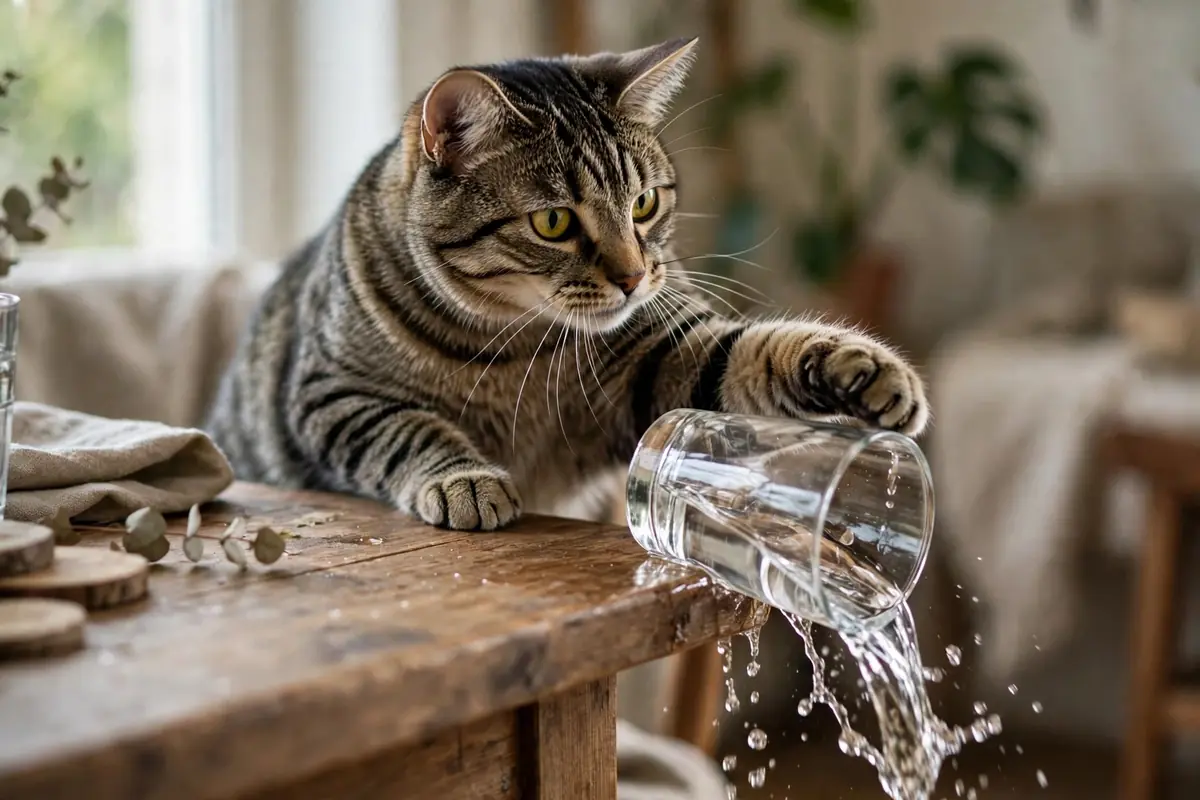
You set your coffee on the table, turn away for one second, and crash — your cat has swatted it onto the floor. If this sounds familiar, you are not alone. Cats knock things over because of a mix of hunting instinct, curiosity, boredom, and attention-seeking, and once they learn that pushing an object gets a reaction, they tend to do it again. The good news is that this behavior is completely normal, and with a few changes around the house, you can protect your belongings without punishing your cat.
Before you assume your cat is being naughty, it helps to understand what is going on in their head. Every swipe of the paw is driven by instincts that served their wild ancestors well. Here are the five most common reasons cats send your stuff flying.
Reason 1: The Hunting Instinct Is Hardwired In
The number one reason cats knock things over is their prey drive. In the wild, a cat tests whether something is alive by tapping it with a paw. A small, light object sitting on a table edge triggers that same response: the cat bats it, it moves, and suddenly it feels like prey. Even a pen, a bottle cap, or your phone can become a "target" in this game.
This is also why cats are so fascinated by objects that roll, dangle, or fall. Movement is the trigger. A still object is boring; a moving object is exciting. When the item drops and makes a noise, the sequence feels complete to your cat — they "caught" something. Indoor cats, who do not hunt real prey, channel this energy into household objects more than outdoor cats do.
If your cat seems to stalk an object before swatting it — crouching low, wiggling their back end, pupils wide — you are watching hunting behavior in action. It is not mischief; it is practice.
Reason 2: Your Cat Wants Your Attention
Cats are far more observant than they get credit for. If knocking a glass off the counter makes you jump up, shout, or rush over, your cat has learned a very reliable way to get your attention. It does not matter whether your reaction is positive or annoyed — to a cat, attention is attention.
Watch for the telltale sign: many cats will look directly at you right before they push something. That sideways glance is no accident. It is your cat checking whether you are watching, because the performance is partly for you. This pattern is especially common in cats who feel ignored during busy parts of the day, such as when you are working from home or glued to your phone.
The fix here is not to scold, which still counts as attention. Instead, make a habit of giving your cat focused playtime and affection at regular times during the day, so they do not need to manufacture a crisis to be noticed. For more on how cats communicate, see our guide on why cats stare at their owners.
Reason 3: Boredom and Pent-Up Energy
A bored cat is a destructive cat. Indoor cats that lack stimulation often invent their own entertainment, and knocking objects off shelves is an easy, endlessly repeatable game. This is closely related to the 3 a.m. zoomies — both are signs of energy with nowhere to go.
Cats need daily play that mimics hunting: chasing, pouncing, and catching. A ten to fifteen minute play session with a wand toy, done once or twice a day, can dramatically reduce table-clearing behavior. Puzzle feeders are another great outlet, because they make your cat work for food the way they would work for prey.
If your cat mostly knocks things over in the evening or overnight, that is a strong clue that boredom is the driver. A good play session before bedtime often leads to a calmer night for everyone.
Reason 4: Curiosity and Learning How the World Works
Cats are natural scientists. When a kitten bats a spoon off the table and it clatters to the floor, they learn something: objects fall, they make sounds, and different objects behave differently. A heavy mug thuds; a light pen skitters; a glass shatters. Each experiment teaches them about cause and effect.
This is especially true for kittens and young cats, who are still mapping out their environment. Even adult cats retain this curiosity, particularly with new objects.
You can satisfy this curiosity safely by giving your cat approved objects to investigate and bat around — crinkle balls, lightweight toy mice, and items that roll. If the need to explore is met through toys, your belongings become less interesting by comparison.
Reason 5: They Are Marking Territory or Testing Boundaries
Less commonly, knocking things over can be part of how a cat claims a space. Cats have scent glands in their paws, so every swipe leaves a faint scent mark on the surface. Pushing objects around a shelf or counter can be a way of rearranging the environment to smell more like them.
This reason is more likely if the behavior appears after a change in the household — a new pet, a new baby, a move, or even rearranged furniture. In those cases, your cat may be feeling unsettled and trying to restore a sense of control over their territory. Keeping their routine steady and giving them vertical space like cat shelves can help them feel secure again.
When Should You Worry About This Behavior?
For most cats, knocking things over is normal and harmless. However, it is worth paying attention if the behavior appears suddenly in a cat who never did it before, especially if it comes with other changes such as hiding, loss of appetite, or aggression. Sudden behavior changes can occasionally signal pain, stress, or illness, and a check-up is wise in that case.
Also consider safety: a cat that knocks over candles, heavy vases, or anything breakable can injure themselves on shards or hot wax. Keep genuinely dangerous items out of reach entirely, rather than relying on training alone.
How to Stop Your Cat Knocking Things Over
- Clear the tempting surfaces. The simplest fix is also the most effective. Keep counters and tables free of small, light objects, especially near edges.
- Use museum putty or sticky pads under decorative items you want to display. They hold objects in place without damaging furniture.
- Play every day. Two short hunting-style play sessions burn off the energy that fuels the behavior.
- Provide legal targets. Balls, crinkle toys, and rolling toys give your cat something they are allowed to bat around.
- Ignore the performance. When your cat knocks something over for attention, stay calm and clean up without a big reaction. Reward calm behavior with attention instead.
- Never punish. Spraying, shouting, or hitting damages trust and usually makes the behavior worse — or drives it underground, so your cat only does it when you leave the room.
With patience and a few household tweaks, most cats reduce this habit significantly. A little chaos comes with the territory of living with one of nature's most entertaining companions. For more everyday cat behavior explained, browse the rest of our guides, or start on the Purrfect Paws homepage.
Frequently Asked Questions
Why does my cat knock things off the table on purpose?
Cats rarely do it out of spite. Most often they are practicing hunting behavior, testing how an object moves, or trying to get your attention. The behavior is usually rewarding for them because something interesting happens every time — the object moves, makes a sound, or you react.
Is my cat knocking things over to get attention?
It can be. If your cat looks at you before pushing something, or only does it when you are in the room, attention is a likely motive. Cats quickly learn which actions reliably make their humans look up, talk, or come over.
How do I stop my cat from knocking things off counters?
Remove temptation by keeping counters clear of small objects, give your cat approved things to bat around, and provide daily play sessions. Double-sided tape on surfaces you want protected can also discourage jumping up in the first place.
Do kittens knock things over more than adult cats?
Yes, kittens tend to be the worst offenders because they are still learning how the world works and have huge amounts of play energy. Most cats calm down somewhat as they mature, though some playful adults keep the habit for life.
Should I punish my cat for knocking things over?
No. Punishment usually backfires — it damages trust and can make the behavior worse, or push your cat to do it when you are not watching. Redirection, environmental changes, and more play work far better.